Anthropic's initial public offering has become a major talking point in the AI industry. For independent software founders, the important lesson is not whether a stock-market debut attracts an impressive valuation. It is what a large model provider's public disclosures reveal about the businesses we depend on—and what we should do differently as a result.
On 26 October 2026, Anthropic made an S-1 registration statement public with the U.S. Securities and Exchange Commission. That is a concrete event. As of this article's editorial cutoff, 31 October 2026, the filing is not the same thing as a completed listing, a final offer price or an established trading history. The preliminary prospectus contains offering details subject to change. Founders should not repeat proposed values or projections as settled facts.
This is a founder-level analysis, not personal investment advice or a prediction of Anthropic's market performance. My question is simple: if your product uses a foundation-model provider, what can you learn from the provider's economics without confusing its business with yours?
What the Anthropic IPO filing confirms—and what it does not
The most useful primary source is the SEC's official filing index. It identifies Anthropic, PBC, a Form S-1, and an acceptance date of 26 October 2026. The registration statement describes a proposed offering and includes a preliminary prospectus.
Reuters' reporting on the filing described the contrast between Anthropic's rapid commercial growth, substantial expenditure and the risks of developing frontier models. That contrast explains why the news matters outside Wall Street: the cost of producing increasingly capable AI is part of the environment in which software entrepreneurs operate.
| Question | What could be verified on 31 October 2026 |
|---|---|
| Has Anthropic publicly filed? | Yes. The SEC index records its S-1 on 26 October 2026. |
| Does the filing prove shares are trading? | No. A registration statement is not a completed debut. |
| Is a headline valuation an established market outcome? | No. Distinguish indicative discussion from final issuance and trading prices. |
| Does investor interest validate every AI startup? | No. Investor demand and product-market fit are separate questions. |
It is reasonable for public-market investors to study revenue, expenses, financing arrangements, competition, governance and risk disclosures. It is also reasonable for software founders to read the filing for context about the supplier ecosystem. But we should resist using a market headline as proof that customers will buy an unrelated application.
A model company and a niche SaaS company have different economics
Foundation-model providers finance model development, computing infrastructure, research, security, and service delivery at substantial scale. Their financial reporting can include risks and cost structures an independent application business does not directly carry. A small SaaS founder might never train a frontier model, rent a data centre or invest in custom AI hardware.
Instead, the application business pays a provider for access, combines that capability with product design and business rules, then sells a complete outcome to a customer. That creates a different set of questions. Can the customer complete a useful task? Does the app fit an existing workflow? How many times does the user return? Can the price cover usage, hosting, support and acquisition?
Suppose you build a reporting tool for field-service teams. It can use a language model to structure rough notes and draft a clear summary. But the outcome the buyer pays for is a trustworthy report with the right jobs, photos, approvals and export. The model's role is one component within a workflow, not the entire value proposition.
This is why I prefer vertical AI products built around a specific task to generic promises about replacing entire professions. The vertical app still has to prove demand, but it can compete on specialist forms, language, integration, trust and practical completion. A general-purpose AI assistant may be capable of many things without being the right way to record a particular regulated or operational process.
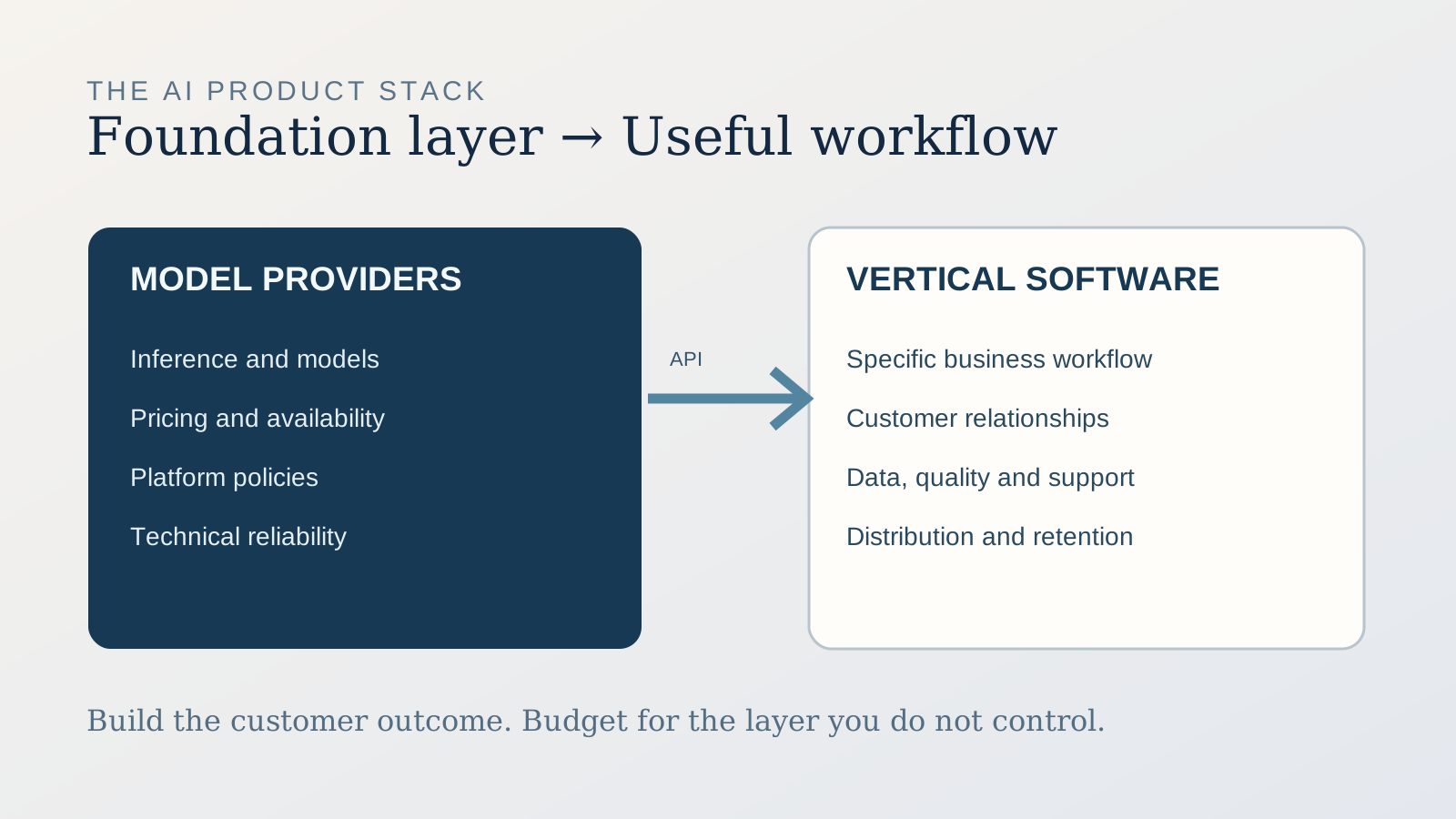
The diagram is a conceptual distinction, not a representation of Anthropic's internal systems or a claim that every niche business must use Anthropic. The Claude Platform documentation is an example of how an independent developer can use an established model through an API instead of operating the foundation layer.
Three implications for independent AI software founders
1. Infrastructure dependence belongs in the product plan
Whenever a feature depends on a model API, someone outside the business controls parts of its behavior, availability, pricing and terms. An IPO can increase attention to a provider's financial condition; it does not make your contract immune from changes. Build a dependency register listing which features call which service, what the application does when the call fails, how much each task costs, and what information is sent.
I would make automated business decisions—particularly prices, permissions, compliance classifications or customer commitments—explainable and auditable. Where a rule can be expressed deterministically, a rule may be more reliable than asking a model to improvise. A model can help people work through text or information, but the business still owns the user experience and failure modes.
2. The durable value is often the niche workflow
Models improve. The existence of an impressive new model can make a feature easier to build, but also easier for competitors to copy. A vertical product should have a reason to exist beyond access to the same API that everyone can purchase. That reason might be workflow-specific data capture, industry terminology, templates, integration into the customer's existing process, support and consistent quality assurance.
For instance, a plumber may need an estimate based on a company's actual pricing rules, not an eloquent guess. A site supervisor may need an inspection report with the right photographs and approval trail, not a generic summary. These requirements are specific enough to test in a customer interview. They are also hard to capture with an investor slide about the size of the AI market.
I discuss the scope discipline behind this approach in A SaaS MVP Needs One Workflow, Not Fifty Features. A useful first release does not have to be enormous. It does have to finish the promised job reliably.
3. Distribution deserves at least as much attention as model selection
Independent founders sometimes spend weeks comparing model outputs while barely testing how a customer will discover the application. Quality matters; an excellent model with no acquisition channel is still not a business. I would identify a reachable buyer and a believable sales motion before optimizing the most expensive model for every task.
Specialist search queries, trade associations, partners and direct prospecting can be more effective ways of reaching a narrow market than mass-market branding. The relevant metrics are qualified conversations, trials that complete the key task, paid conversions, retention and acquisition payback. Total app downloads or social-media impressions are not substitutes for those measures.
Distribution also affects defensibility. A product embedded in a trusted customer relationship can remain useful as models change. A generic tool relying exclusively on temporary search hype may lose traffic as easily as it acquired it.
Why an enthusiastic IPO market would not prove product-market fit
Public-market investors and SaaS buyers purchase different things. Investors purchase a financial claim on uncertain future returns. Customers purchase relief from an actual problem under a specific budget, workflow and contract. These decisions can be influenced by the same technology trend but cannot validate each other.
Even if the Anthropic offering later attracts considerable demand, that would not prove that a niche AI CRM, reporting app or marketing assistant has sufficient retention. Equally, a market correction would not automatically eliminate the value of a profitable app that customers use every day.
That is the mistake I would avoid: saying “AI is a trillion-dollar opportunity, therefore this application deserves a large build budget.” Broad addressable-market figures are poor evidence for whether ten buyers will adopt a specific first product. A buyer interview, a paid pilot and a month of repeat use usually provide much more actionable evidence.
For a practical way to run those tests, see How I Evaluate Micro SaaS Ideas Before Writing Any Code. The goal is not to reject AI enthusiasm; it is to translate interest into observable customer behavior.
A simple vendor-change and cost contingency plan
Depending on an external model is not inherently bad. Most small companies depend on cloud hosting, email services, payment processors or third-party software. The risk comes from not knowing which dependencies can break an essential workflow or destroy the economics.
I would maintain a single page covering the provider and current model; requests per customer action; average and heavy-use costs; rate limits; uptime and error handling; data-processing terms; any provider-specific prompting or tool formats; the model's quality tests; and the practical time required to migrate. Update it when a provider changes something material.
A second model provider can be an option, but promising instant interchangeable failover is unrealistic for many applications. Different models may require different prompt designs, evaluation suites, tool-calling logic and safety controls. A fallback should be tested against the real workload rather than assumed to be a drop-in replacement.
Budget for a scenario in which API costs rise, responses become slower or customers submit much longer documents. If the service charges a flat fee, define reasonable usage boundaries. If you charge by volume, make billing understandable. In both cases, track direct support and human review costs—especially where a model's output must be verified.
Security is part of this contingency work. Know which customer data enters a provider system and which people can view it. Obtain the required permission to process data and offer a defensible retention and deletion approach. The NIST AI Risk Management Framework provides a useful broader reference for assessing AI-related risks, though it is not a substitute for sector-specific legal or security review.
A seven-step checklist for the next month
- Choose one buyer and workflow. Write the event that triggers use and the output the buyer needs.
- Talk to prospective customers. Seek recent, detailed examples of the problem and who would authorize payment.
- Make a real offer. Request a paid pilot or a commitment with clear scope and expectations.
- Test at realistic usage. Include long documents, difficult requests, errors and high-frequency users.
- Calculate the unit economics. Include provider fees, storage, support, payments and acquisition before projecting profit.
- Document your fallback. Decide how the customer completes the task during a provider outage or model change.
- Use retention to decide. Expand only when users repeatedly complete the task and a credible share remain willing to pay.
My preference is to give a small, finished workflow the chance to prove itself before assuming that a wave of investment will carry an unfinished application. The public market can offer useful signals about provider funding and cost pressure; customer evidence still decides whether the product earns its place.
The independent founder's advantage is focus
Anthropic's public filing is a meaningful event for the AI industry. It may help investors assess the provider's reported risks, spending and prospects. For founders, its more useful role is to expose the scale of the infrastructure behind an API call—and encourage discipline about dependency and cost.
We do not need to own a foundation model to build a business. We need to know what outcome customers want, what will deliver it reliably and what they will pay. That is a different game from raising money to train frontier models, and the distinction is worth preserving regardless of how the IPO eventually performs.
I build and explore focused business software through NIR.Systems. You can also browse my work and other founder notes. The aim is not to sell an investment story; it is to build tools that justify their existence one customer workflow at a time.
Frequently asked questions
Has Anthropic already completed its IPO?
Its Form S-1 was filed publicly on 26 October 2026. That filing did not by itself establish a completed offering or public trading. Check current SEC materials and reliable market reporting for any later developments.
Should an AI founder build a proprietary foundation model?
Usually the first question is whether a model-specific advantage is essential to the customer outcome and whether the capital and specialist expertise can be justified. Many focused workflow products can begin by purchasing model access rather than training frontier models.
Does the filing make AI applications safer investments?
No. Infrastructure company disclosures and an individual application's product-market fit are distinct. A founder should test customer demand, unit economics and platform risks independently.
- U.S. SEC — Anthropic Form S-1, filed 26 October 2026.
- Reuters — Reporting on Anthropic's filing, 26–27 October 2026.
- Claude Platform — Official API documentation.
- NIST — AI Risk Management Framework.
Editorial cutoff: 31 October 2026. A filing is not a listing. This article is product strategy analysis and does not recommend buying or selling securities.