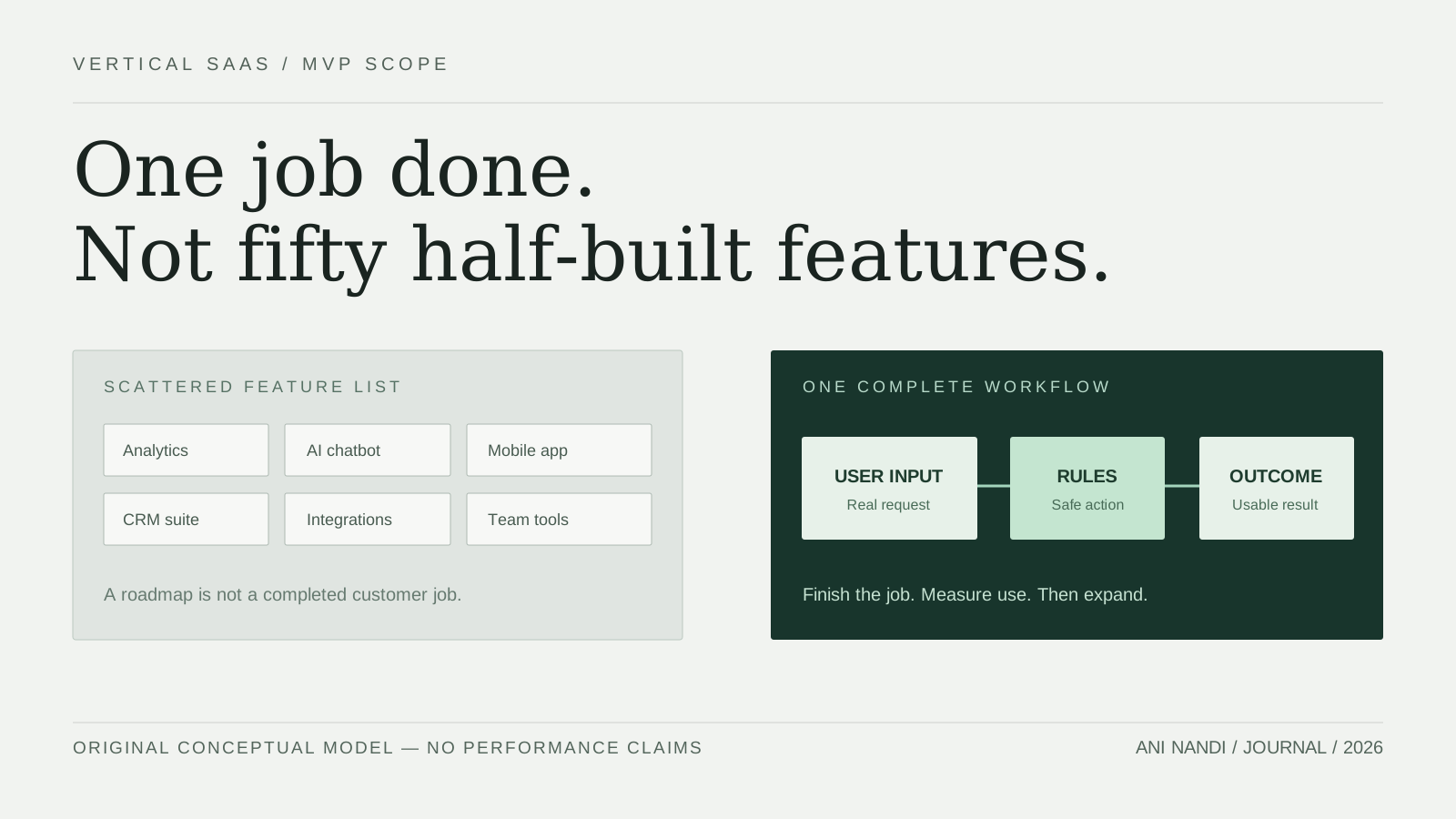
An MVP is supposed to reduce uncertainty. Yet many early SaaS projects make the first release so broad that the founder cannot tell which part of the product anyone actually values. I would rather ship one workflow a real customer can finish than fifty features a prospect can only admire.
Why I prefer one finished job to a crowded roadmap
When a founder describes an early software idea, the conversation often starts with a list of features: dashboards, automation, artificial intelligence, analytics, team permissions, payments, reports, notifications and a mobile app. Each feature sounds defensible in isolation. The combined list can hide the question that actually matters: what painful task can one customer finish with the first version?
I build focused business software through NIR.Systems. My starting point is not the number of screens a product might eventually contain. It is the outcome a user needs, the sequence of actions required to reach it and the evidence that would tell me whether the outcome matters enough for someone to use or pay for.
My working rule is simple: a SaaS MVP should deliver one complete, credible workflow before it attempts to become a broad operating system. That is not the same as building only one feature. The workflow may need authentication, data storage, calculation rules, error handling and an export. Those capabilities are supporting pieces of the same customer job.
The trade-off is deliberate. You give up the appearance of a comprehensive platform to gain a more honest test of demand, usability and operating cost. The smallest credible experience is usually more informative than the largest unfinished roadmap.
What a SaaS MVP is—and what it is not
An MVP, or minimum viable product, is the smallest real offering that lets a defined audience experience value and gives the founder useful evidence for the next decision. Y Combinator's MVP design guidance separates a complete product function from a collection of features, while academic research similarly frames an MVP as a limited offering deployed to learn from users.
For a SaaS business, the word viable matters. A static interface is useful for exploring a concept, but it does not prove that the software can complete the job reliably. A mock booking button is not a booking workflow. A beautifully formatted invoice page is not an invoice system unless a real user can enter data, create the document and retrieve or deliver it as promised.
At the other extreme, an MVP is not a shrunken enterprise application that includes every module in a cramped interface. I distinguish three stages: a prototype tests understanding or interaction; an MVP performs a real job in a constrained setting and tests an important assumption; a scalable product adds breadth, resilience and operational capacity after the core use case has evidence behind it.
These categories are not labels to impress investors. They help prevent a prototype from being sold as a production-ready service and prevent an MVP from carrying requirements the first customer has never asked for.
The customer workflow comes before the feature list
I write the first product specification as a sentence: For [specific user], when [trigger] happens, the product turns [inputs] into [valuable outcome], so they no longer need [current workaround]. If I cannot finish that sentence clearly, I am not ready to create a backlog.
Take a small home-service company. A customer asks for a quotation. Someone needs to gather service details, apply known pricing rules and respond without losing the enquiry. The valuable workflow is not “a dashboard with CRM integration.” It is request → structured details → rule-based estimate → captured lead → human follow-up.
Now consider a field technician finishing a job. The useful outcome is a reliable customer-ready record: job → checklist → notes and photographs → customer acknowledgement → report. A social feed, employee leaderboard or complex analytics suite would not improve the first completed report.
A workflow has a starting trigger, a user, required input, an action, an observable output and a clear end. A feature is something that helps the workflow succeed. This distinction changes scope decisions: every proposed feature must explain which step it improves and which failure or learning gap it resolves.
Example one: QuoteFlow and a rule-based service quote
On QuoteFlow's public product guide, the core offer is specific: a customer enters the relevant service information, configured pricing rules produce an estimate and the business receives a priced lead to review. The pricing calculation is rule-based, not an AI model guessing a price. That matters because the business needs an explainable number based on its own rates and variables.
Here is how I would express the first useful scope of a quoting product:
- The business specifies services, base prices and the variables that affect each estimate.
- The customer selects a service and answers the relevant questions.
- Validation checks that required information is usable.
- The configured rules calculate and display an appropriately qualified estimate.
- The business receives the customer's enquiry and the underlying inputs so it can follow up.
That is more than one screen, but it is still one job. It also exposes product assumptions: Can a typical provider express its pricing as consistent rules? Will the customer complete the form? Is the estimate useful enough to trigger a follow-up? Do operators trust the inputs and calculation?
My preference would be to test those questions before discussing AI-generated marketing copy, advanced sales pipelines, calendar synchronization or multi-branch performance reporting. Those might be useful later. None should be allowed to make a simple quote unreliable or difficult to complete.
The public guide establishes what the product claims to do; it does not establish conversion uplift, quote completion rates, profitability or customer retention. I would need actual usage evidence before making those claims.
Example two: FieldReport and a finished job record
FieldReport addresses a different professional workflow. A technician records work completed through checklists, notes and photographs, obtains the necessary customer acknowledgement and produces a professional report. The product's public material emphasizes documentation and proof of work rather than a general-purpose field-service ERP.
A focused first version would therefore prioritize readable forms on a phone, preserving the job information, associating photos with the correct record, confirming what has been signed or acknowledged, and generating an accurate report. If the final PDF omits an important image or the technician cannot save progress reliably, the core workflow has failed—even if the dashboard looks impressive.
I would place scheduling optimization, payroll, fleet tracking, full inventory management and a multi-company command center outside an initial proof-of-work MVP unless an actual buyer demonstrated that one of them was essential to finishing the documented job.
QuoteFlow and FieldReport show why I favor a vertical product description. “Quoting software for service businesses” and “job documentation software for technicians” give the buyer a reason to evaluate the product. “All-in-one AI-powered business platform” can be so broad that nobody knows what problem it solves first.
A feature-priority table that forces a real decision
The easiest way to lose the MVP is to treat every desirable improvement as a first-release dependency. I use a three-column decision: needed to complete the promised job, needed to operate it responsibly, or deferred until customer evidence supports it.
| Capability | First-release decision | Why |
|---|---|---|
| Quote input and validation | Include | Without usable inputs, the quote is not credible |
| Configured pricing rules and calculation | Include | This is the central value delivered |
| Lead capture and operator handoff | Include | The estimate must reach the business |
| Authentication and safe data access | Include where required | Protect records and prevent unauthorized actions |
| Readable errors, recovery and basic logs | Include | Real customers will encounter failure states |
| Enterprise analytics dashboard | Defer | Does not prove the quote workflow is valuable |
| Native mobile applications | Defer if responsive web works | A separate app may add complexity without improving the job |
| AI-generated price recommendations | Defer or reject | Unnecessary when transparent rules are the requirement |
| Dozens of integrations | Defer until evidenced | Each adds dependencies and failure modes |
The decisions in this table are illustrative scoping choices, not an audit of which features are currently built into either NIR product. A particular customer may need an integration or role control earlier. The product specification should explain that exception rather than silently broadening the roadmap.
The one-page MVP brief I use to push back on scope creep
Before implementation, I want a short document that can be read by a founder, builder or prospective pilot customer without a meeting. It should state what the product is trying to prove and what it is explicitly refusing to build.
| Brief field | Example: rule-based quoting MVP |
|---|---|
| Primary user | Owner or estimator at a small service company |
| Trigger | New enquiry requesting a price estimate |
| One job to finish | Collect requirements, calculate an estimate and capture a usable lead |
| Core assumption | Owners will adopt this flow instead of manual initial quoting for suitable jobs |
| Inputs | Service, quantity, options, location if relevant and contact details |
| Output | Labelled estimate plus reviewable operator record |
| Acceptance test | Realistic cases return expected prices and can be followed up without missing data |
| Observable signal | Completed quotes and operator willingness to keep using the workflow |
| Not in version one | Payroll, CRM suite, native apps, generative pricing engine |
| Stop or revise signal | Users cannot express pricing rules clearly or repeatedly abandon the flow |
Writing the not in version one row is essential. Without it, every new suggestion silently becomes a future obligation and the first version never stops expanding. Microsoft-published MVP framing guidance similarly emphasizes a concrete learning goal, end-to-end value, measurable outcome and explicit out-of-scope decisions.
The technical foundation cannot be optional
“Build less” must not be interpreted as “ignore the things a real product requires.” A one-workflow MVP can still process customer information, expose documents, apply money-related calculations or trigger operational actions. Those systems need appropriate safeguards even when only a few pilot users are involved.
My minimum technical review depends on risk, but I would examine authorization and access controls, input validation, data handling, secret management, backup or recovery requirements, failure messages, observability and the ability to correct a broken release. For files and customer records, access must be restricted so one company does not accidentally see another's material. For calculations, I want representative test cases that can be checked against an independent expected answer.
If the business processes sensitive or regulated information, the scope may need additional controls before launch. Sometimes the right MVP is a constrained pilot with limited data rather than a public self-service app. A security or legal requirement does not become optional merely because it interferes with a feature-count target.
Deployment discipline also matters. Vercel documents distinct Local, Preview and Production environments. I prefer to test a scoped change on preview, inspect the complete user journey and then release it deliberately. The ability to deploy quickly should not be confused with evidence that the product is ready.
How I decide whether a request is actually essential
Early customers can be generous with ideas. Some suggestions reveal a serious gap; others describe an adjacent product. I do not want to dismiss either, but I also do not let a single conversation rewrite the entire roadmap.
For each request I ask: Which step in the first user workflow is failing? Is the feature required to complete the job, meet a safety or legal obligation, or verify the main adoption hypothesis? Can a reliable manual workaround handle it during a bounded pilot? What new operational responsibility or dependency would the feature create?
Take a request for automated reminders. If the MVP is a customer quoting tool, reminders may help sales follow-up. But if the initial quote cannot be generated accurately, reminders are downstream polish. In a document-production tool, automatic email delivery might be core if users cannot finish the job without it; in another setting, a downloadable PDF and manual send may be sufficient for the first pilot.
The answer is contextual. A “one-workflow” principle is useful only if it forces specific trade-offs. It is not permission to say no reflexively. If an excluded requirement repeatedly blocks successful completion for the target customer, the correct response is to revise scope rather than defend a neat framework.
The metrics I would actually monitor
Pageviews and signups can help describe interest. They do not, by themselves, establish that a SaaS MVP solved the intended problem. I want evidence at the point of value: what happened when someone attempted the whole workflow?
For a quoting workflow, I would look at the share of starts that become usable estimates, where people abandon the form, whether the underlying pricing rules match the business's approved cases, whether the operator receives complete details and whether the operator chooses to keep using the system. For a field report, I would look at completed records, missing photos, failed exports, required corrections and whether the report is useful to the customer.
These are proposed measurement categories, not disclosed performance figures from NIR.Systems. A founder should set an observation window and minimum evidence threshold appropriate to the acquisition channel and risk. Tiny pilot samples are informative for finding defects and qualitative friction; they are generally insufficient for precise claims about conversion percentages or long-term retention.
The commercial signal becomes stronger when a qualified user is willing to pay, repeatedly uses the service or explicitly replaces an existing manual process. I would separate curiosity from commitment, and commitment from sustained economic value.
When to use manual work behind the scenes
Not every step needs software automation on day one. An owner might approve exceptional quotes manually. A support request might arrive by email. A developer might correct a report template after discovering a legitimate edge case. That is not necessarily a failure of the MVP; it can be the least costly way to learn before building expensive infrastructure.
But manual intervention must be transparent and safe. If marketing promises instantaneous automated decisions while a person actually provides them, the customer deserves accurate disclosure. If the number of human corrections makes each transaction unprofitable, that is a commercial warning rather than a sustainable operating model.
The question is whether manual work is a measured temporary bridge that helps verify demand or a permanent hidden dependency that undermines the product. I would record the handoffs and their cost. As recurring patterns emerge, the next automation decision becomes evidence-based rather than driven by novelty.
The cost of fifty features is bigger than development time
Every added feature increases the surface area that needs to be explained, tested, supported and kept compatible. A scheduling module may require calendars, time zones and conflict management. Role-based teams add authorization complexity. Payment flows add billing state and refund handling. Integrations create external dependencies. More modules also create more ways to damage the core workflow during an update.
There is a positioning cost too. A product trying to handle every back-office task competes for attention against mature software suites. A focused product can explain its value in one sentence and reach a narrow buyer segment with a more relevant demonstration. That does not guarantee commercial demand, but it makes the test more coherent.
I would rather discover early that a quoting tool is not sufficiently valuable than learn the same lesson after building a CRM, scheduling suite and reporting platform around it. The latter route burns more time while providing no necessarily better evidence about the original business hypothesis.
A practical pilot and the decision gates
A disciplined MVP plan is a sequence of decisions, not a promise to launch in a fixed number of days. I would first interview a small number of relevant operators about the current job, collect representative examples, document the workflow and build the narrowest version that completes it.
- Problem gate: Can prospective users describe recent, costly friction in the job without being led? If not, investigate demand before coding.
- Scope gate: Can one person finish the job with the proposed workflow and minimum safety requirements? If not, revise the flow.
- Technical gate: Do valid, invalid and recovery cases work; can records be accessed appropriately; and can failures be diagnosed?
- Pilot gate: Can a small number of suitable users complete the task in their own context without the founder guiding every click?
- Commercial gate: Is there credible evidence of repeat use, payment intent or a paid commitment that justifies further investment?
A stop decision is a valid outcome. If users have no urgency, the workflow requires too many exceptions or the operating costs overwhelm the value, I would reconsider the audience or the problem before adding features. If an early pilot shows a clear repeated need, I would add one targeted improvement and test again.
When one workflow is too narrow
The title of this article is a discipline, not a literal law. Certain products cannot honestly create value through a single isolated transaction. A compliance tool may need approval history and auditability from the first release. A collaborative product may require two user roles. A marketplace needs enough of both sides to complete an exchange. A billing product must handle more than a successful payment, including errors and cancellations.
In those cases, I define one coherent outcome rather than one button or one user screen. The MVP is allowed to contain all the interdependent steps necessary to deliver that outcome safely. What I would challenge is the addition of an unrelated second, third and fourth product line before the first is working.
For example, creating a trustworthy customer report may need a technician and a customer acknowledgement step. That is still one end-to-end job. Adding workforce payroll to that same first release would be a different business question.
What I would build next—and what I would not
For a hypothetical first release of QuoteFlow, I would prioritize getting accurate rule-based estimates from properly configured services to the customer and business owner, then validating real-world usage and exceptions. I would not add a generic AI chatbot merely to put AI in the headline. The public NIR product FAQ already explains why predictable pricing rules matter to that use case.
For FieldReport, I would prioritize trustworthy job capture and a readable professional output, then investigate the bottlenecks the technician actually encounters. I would not build fleet tracking or a full ERP without evidence that the target user needed them to complete the job.
For a completely new SaaS idea, I would begin with the business problem, not the development tool. I have also written about evaluating micro-SaaS ideas before writing code and keeping product decisions in human hands when AI writes code. Those decisions come before deciding which features deserve to exist.
My recommendation: choose one customer, one costly recurring task and one clear result. Build the smallest responsible workflow that delivers the result. Observe what real users do. Let that evidence—not a feature wishlist—decide version two.
- Y Combinator — Practical Design: MVP Spec — distinction between a complete product function and a collection of features.
- Y Combinator — One Order of Operations for Starting a Startup — launch a constrained product and learn from actual users.
- Microsoft's public MVP-framing reference — explicit learning goals, end-to-end value and out-of-scope decisions.
- Vercel — Deployment environments — technical context for preview versus production releases.
- NIR.Systems — QuoteFlow product guide — public functionality and rule-based quote design.
- NIR.Systems — FieldReport product guide — job documentation and customer-ready reports.
- NIR.Systems — Product FAQ — publicly described workflows and limits.
Editorial disclosure: I build and operate NIR.Systems. The first-release scope tables above are illustrative product-decision frameworks, not a statement that every listed feature is or is not implemented. No customer counts, adoption results, revenue, time-savings or conversion statistics are claimed. Third-party guidance is linked for context; the prioritization and examples are my analysis.