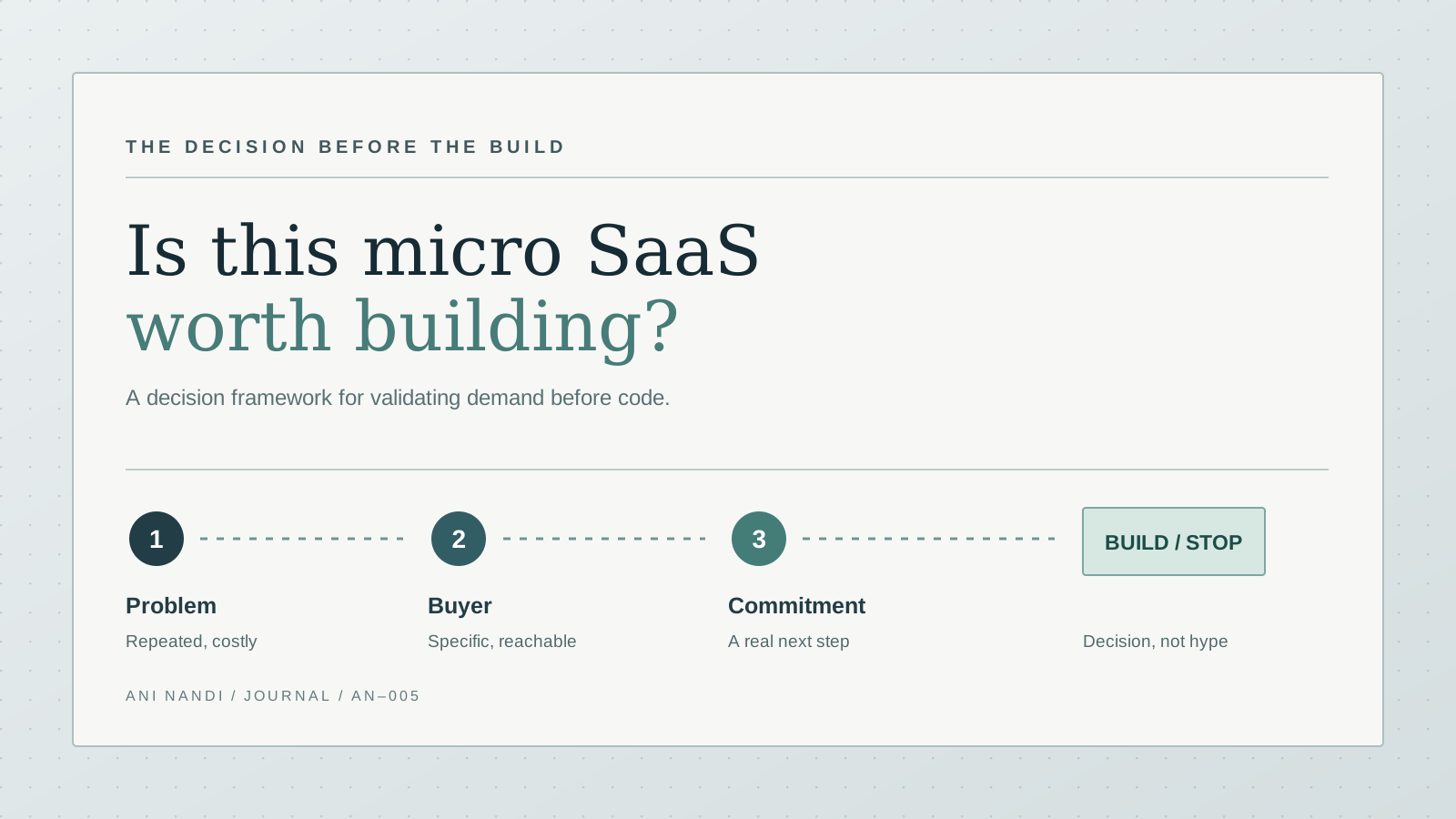
AI can make it easier to produce working software. It has not made finding paying customers easier. That is why I evaluate the business case for a micro SaaS idea before treating it as a coding project.
The best micro SaaS ideas begin with a narrow, expensive problem
When I evaluate micro SaaS ideas, I am not looking for the cleverest feature. I am looking for a specific kind of business problem: it happens repeatedly, somebody is responsible for fixing it, the current solution wastes money or time, and that person can realistically buy a better one.
Micro SaaS usually means a relatively focused software product that serves a narrow market and can be run with a small team. It does not mean effortless passive income. Hosting, bugs, onboarding, support, billing, data protection and churn do not disappear because the product is small.
My starting question is deliberately unfashionable: Who will care enough about this problem to change their behaviour and pay? A beautifully built dashboard is not evidence that somebody needs another dashboard. This article sets out the decision framework I use when assessing a possible product, along with its limits. The scoring numbers are illustrative criteria, not measured results from a customer-research study.
1. Define a customer and a job in one sentence
“Software for small businesses” is too broad. “A photo-based job report that a field technician can finish before leaving the site” is a more testable starting point. It identifies a user, a moment in a workflow and an outcome. A niche is useful because the first product can be good at one job without claiming to serve everybody.
I write an initial hypothesis in this form: For [specific role] who [specific recurring situation], the current process causes [measurable consequence], and a useful tool could deliver [clear outcome]. If I cannot fill that in without vague phrases such as “save time” or “streamline operations,” I am not ready to consider features.
The buyer and user may differ. A tradesperson might create the report, but an office manager or owner may approve the subscription. A product can please the employee and still fail if the owner sees no business value. I record who uses it, who authorises payment, and who experiences the cost of doing nothing.
2. Look for an existing workaround and evidence of pain
Before coding, I want to know how the task is handled today. It might be a spreadsheet, a group chat, a paper form, a generic CRM, a virtual assistant, or a larger software package used for only one feature. A workaround is important evidence: people have already spent effort to make the problem manageable.
I ask what happened the last time the problem occurred, how long it took, what failed, who noticed, and what it cost. These answers are stronger than general complaints about “inefficiency.” One person saying they dislike a spreadsheet is weak evidence. Several independent buyers describing the same costly workaround is more interesting, although it still does not establish willingness to pay.
Competition is not automatically a reason to stop. The question is whether there is a credible wedge: a simpler workflow, a narrower role, a faster implementation, more appropriate reporting, or a service level that existing products do not provide. I also check whether the supposed gap is already solved by an affordable feature in a platform the customer owns.
3. Run problem interviews without pitching the answer
My preference is to speak with the role that lives with the problem, not only friends who think the product sounds exciting. Interviews should produce a list of actual tasks and past events. I do not begin by showing a mock-up and asking, “Would you use this?” That question tends to collect polite reactions.
A useful short interview covers five things: the last occurrence of the problem; the sequence of steps; the current tools and costs; the consequence of a mistake or delay; and who can authorise a change. If the customer struggles to remember a recent example, the problem may be too infrequent to deserve another subscription.
I keep separate columns for what the person did and what they said they might do. I also make a note of disconfirming evidence. If buyers genuinely like their existing tool, have no budget, or face a long procurement process, those are not objections to talk away; they are inputs to the decision. Y Combinator's Startup School session on how to talk to users is a useful independent reference for this style of discovery.
4. Check discoverability and the real competitive set
A small product still needs distribution. I map three channels before thinking about a build: people I can approach directly, communities or professional networks where the role already participates, and queries that indicate active purchase or problem-solving intent.
Search volume is a useful clue, not a sales forecast. An informational search for “micro SaaS ideas” is different from a buyer searching for software to create site inspection reports. I review the actual results and product pages before assuming a keyword will send qualified leads. I also read competitor positioning, publicly available customer complaints and pricing pages, while separating current facts from guesses about their revenue.
The U.S. Small Business Administration's business-planning guidance makes a similar distinction between knowing a target market and researching competitors. Market presence tells me a category exists; it does not prove that I have a winning proposition or an affordable way to reach the buyer.
5. Score the opportunity before deciding to build
I use a compact decision scorecard rather than a long feature roadmap. Each dimension gets a score from 0 (little credible evidence) to 5 (strong direct evidence). A score represents the current quality of evidence, not an objective measurement of market demand.
| Criterion | What would earn a high score? |
|---|---|
| Problem frequency | Repeated workflow with recent, specific examples |
| Economic pain | Clear cost of errors, delay, rework or lost sales |
| Buyer access | Reachable decision makers and a realistic sales channel |
| Payment evidence | Actual budget, paid pilot or informed commitment |
| Delivery simplicity | One workflow with manageable integrations and obligations |
| Defensible difference | A benefit buyers can explain beyond “more AI” |
That produces a total out of 30. My illustrative decision rule is: below 15, investigate or discard; 15–22, narrow the proposition and run a stronger test; 23 or more, consider a small paid pilot provided no critical risk is unresolved. These boundaries are an internal prioritisation device, not validated benchmark thresholds. A low score in payment evidence or regulatory feasibility can override an impressive total.
The most useful result of scoring is often finding one untested assumption. If I am certain the workflow is painful but have never asked anyone to pay, the next task is not software architecture. It is a price-and-commitment test.
6. Build the economics from the bottom up
A micro SaaS opportunity should fit the income target without requiring a wildly optimistic customer count. I prefer simple unit economics to large market-size slides. Start with the number of relevant buyers that could plausibly be reached, a price based on value, the cost of delivery, and the support load the workflow creates.
Hypothetical calculation: suppose a narrow niche contains 4,000 reachable buyers. If 3% eventually subscribe at $49 per month, that is 120 subscribers and $5,880 in monthly recurring revenue before payment fees, hosting, AI usage, support, tax, churn and acquisition expenses. The 4,000, 3% and $49 are made-up scenario inputs, not researched demand figures. A different conversion assumption changes the model dramatically.
For an AI-heavy product, I estimate usage per customer and stress-test high-volume accounts. For a service-assisted product, I count human onboarding and exception handling. Gross margins can look attractive on paper until every customer requires a custom import or weekend support. I also compare the result with the opportunity cost of improving a product or business that already has customers.
7. Reject the idea if the operational burden defeats the niche
Not every small-sounding application is a small business to operate. A tool holding patient information, handling financial transactions, or making decisions with safety implications may create substantial security, privacy and compliance requirements. Even a reporting product needs sensible access controls, backup expectations, retention rules and a way to handle erroneous data.
I list required integrations and failure modes before estimating build time. Will customers demand migration from an incumbent? Does a vendor API allow the needed workflow? What happens when the network is down? Can the result be reviewed by a human? What is the manual recovery path? A prototype that works once in a demo does not answer those questions.
The relevant question is not merely, “Can AI write the app?” It is, “Can I sell, operate, support and improve this responsibly at the expected price?” I explore that implementation distinction in how I build working software with AI.
8. Test a real offer before the full product
When the buyer, problem and economics look credible, I move from opinions to behaviour. A short landing page can state the customer role, outcome, boundaries, proposed price and a clear next step. That may be a booking for a scoped pilot rather than a generic “join the waitlist” button.
A transparent concierge test is often stronger: deliver the result manually for a limited number of customers and document whether they value it. If the task is creating a structured job report, a manually prepared sample from properly authorised inputs can reveal what matters before a complex software build. The buyer knows that the service is a pilot and that the finished software may not exist yet.
A paid pilot or pre-order can provide stronger evidence of purchase intent, but it must clearly disclose availability, scope, refund terms and delivery obligations. Stripe Payment Links is one documented option for accepting one-time or recurring payments without building a custom checkout; it is not necessary for every market or a substitute for valid commercial terms.
I do not use a simulated successful payment or a vague waitlist count as proof of revenue. The test should measure a behaviour that actually addresses the risky assumption: booking a meeting, providing relevant source material, agreeing to a paid pilot, or paying under clear terms.
9. A concrete example: specialist field reporting
Consider a hypothetical product for small field-service businesses that repeatedly need to turn site notes and photos into client-ready reports. One possible workflow is: technician captures job details → the system organises photos and notes → a manager reviews → the customer receives a clear report. The buyer may value faster administration, fewer missing details or better handovers, but those benefits would need to be tested with real teams.
NIR.Systems publicly describes FieldReport as job-reporting software with photos and signatures, alongside QuoteFlow for quoting and lead capture. These public product descriptions are useful context for the kinds of focused problems I investigate. They do not establish a particular number of users, customers, revenue, hours saved or completed interview results.
Before proposing another product in this category, I would ask what FieldReport or an incumbent tool fails to cover, whether that gap is frequent, and whether it can be addressed more cheaply through a product improvement rather than a new standalone application. A good adjacent idea can still be a bad new business if it merely duplicates an existing product with a slightly different interface.
10. My practical seven-step pre-code review
- Write the one-sentence job. Name the role, recurring trigger and expected business result.
- Collect recent workarounds. Ask people to show or describe what they did last time, with permission and without collecting unnecessary private data.
- Map alternatives. Include spreadsheets, services, incumbent software and features of products the buyer already owns.
- Identify the buying path. Learn who approves spend, what budget category exists and what would trigger a switch.
- Model the small market. Make customer, price, churn, support and acquisition assumptions visible; label them honestly.
- Present an honest pilot. Seek a meaningful commitment rather than compliments or broad signup numbers.
- Make a written decision. Build a minimal workflow, narrow the buyer, repeat one test, improve an existing product, or stop.
These are steps, not a mandatory seven-day countdown. A product for regulated buyers may require much more discovery than a simple reporting tool. The point is to make the next decision cheap enough that I can change my mind when the facts change.
What makes me stop an idea
I become sceptical when the problem is occasional, the buyer has no authority to pay, the product depends on hard-to-access data, or all differentiation comes from a generic AI feature. I also pause when customer acquisition only works if every visitor converts at an optimistic rate, or when a tiny subscription hides an expensive human support obligation.
Another warning is building for an audience that likes talking about software more than buying it. Maker communities can be useful for feedback, but a tool for electricians should ultimately be validated with electricians or the businesses that employ them. Industry knowledge and distribution access are part of the product strategy.
Stopping is not wasted work. A documented “no” saves engineering time, hosting cost and attention. It may also reveal a smaller feature that strengthens a product already in operation. In a portfolio of businesses, that can be the more profitable decision.
Frequently asked questions
How many micro SaaS ideas should I validate at once?
Enough to compare opportunities, but not so many that interviews become superficial. I prefer a short candidate list, then a focused test of the strongest problem. If no idea has a credible buyer, do more discovery instead of building several prototypes.
Is search volume enough to validate a SaaS product?
No. Search data can show language and interest, but it does not establish a budget, the buyer's urgency or willingness to change tools. Transactional intent, competitor use, buyer conversations and real commitments add context.
Should I build an MVP before speaking to customers?
Usually I would not. A sketch, sample report, manual service or tightly scoped landing page can answer the first commercial questions faster. A working prototype becomes valuable when a real user needs to test a specific interaction that words cannot reveal.
How do I know when the idea is validated?
There is no universal threshold. I want evidence that a reachable buyer has a recurring problem, accepts the proposed value, and will take an appropriately meaningful step toward purchase. That justifies the next experiment; it does not guarantee retention, profit or product-market fit.
The decision matters more than the code
The part I find most valuable about micro SaaS is its discipline. A small product can solve one job extremely well. But the smallness of the product is not a reason to skip commercial research, support planning or technical responsibility.
Before writing code, I want to be able to state who buys, why the problem matters, how they solve it today, what makes the alternative better, what the economics might look like, and what evidence would make me stop. When those answers are grounded, the build becomes a means of delivering value instead of the experiment itself.
For examples of focused, specialist software categories, see the current offerings at NIR.Systems. The useful question is not “Which app should I launch next?” It is “Which specific problem has earned the right to become a product?”
Independent references and methodology
- Y Combinator Startup School — How to Talk to Users (customer interviews and interpreting feedback).
- U.S. Small Business Administration — Plan Your Business (target markets and competitive research).
- Stripe — Payment Links (documented no-code payment functionality).
- Google Search Central — Creating Helpful, Reliable, People-First Content (editorial sourcing and reader value).
- NIR.Systems — Official Product Pages (public descriptions of QuoteFlow and FieldReport).
Evidence note: This article is an analytical founder decision framework. The rubric, revenue example and field-report scenario are conceptual, not measured results of a completed market test. Current product descriptions were checked in October 2026; product availability and pricing can change.