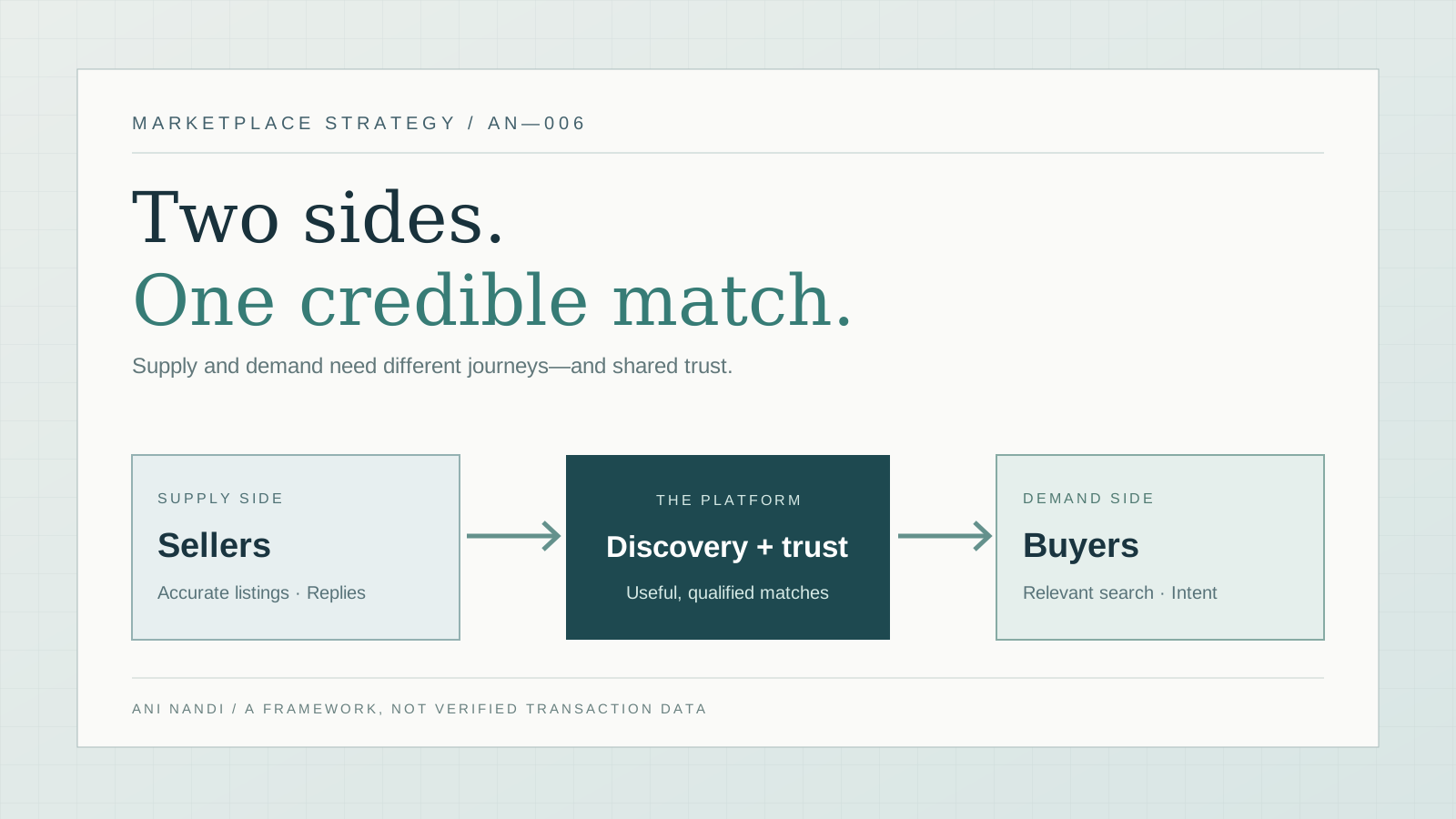
When I look at a marketplace idea, I ask a question that comes before design, code or advertising: why will both sides show up—and why will either side come back?
A two-sided marketplace is two businesses connected by one promise
A two-sided marketplace connects two interdependent groups—usually people who want to buy something and people who can supply it. The platform helps them discover each other, assess a fit and, in some models, complete an exchange. Its challenge is not merely building a catalogue or collecting sign-ups. It must make participation worthwhile on both sides.
A conventional ecommerce store selling its own products has customers and suppliers, too, but that does not automatically make it a two-sided platform. A merchant controls or sources an offering and sells it to the customer. In a marketplace, independent sellers or providers offer to independent buyers through a coordinating platform. That distinction changes the revenue model, product design, responsibility for quality and growth strategy.
The research literature calls the related attraction problem the chicken-and-egg problem. If buyers cannot find suitable listings, they leave; if sellers receive no serious enquiries, they stop investing time in the platform. Harvard Business School's explanation of two-sided platform network properties describes this interdependence. I think of it as a pair of businesses sharing one promise: the marketplace must make the next useful match easier than the alternative.
1. Design two customer journeys, not one homepage
It is easy to design the attractive buyer-facing page first: a search box, polished listing cards and a call to action. But the other half of the marketplace is the workflow required to create, maintain and respond to those listings.
The buyer wants an answer: Can I find something relevant, understand it, trust it and take the next step? The seller wants a different answer: Can I describe what I offer without too much effort, reach serious buyers and get value for the fee or time I invest? The interface may use one visual system, but the onboarding, evidence requirements, notifications, economics and failure points differ.
For a business-for-sale marketplace, buyers may filter by sector, geography, price and available financial information. Sellers may need confidentiality controls, listing review, lead screening and a clear method for managing enquiries. For a commercial-kitchen directory, buyers want an appropriate location, permitted use, equipment, access conditions and pricing. Kitchen operators need accurate profiles and manageable enquiries. If either workflow fails, an elegant homepage cannot repair the experience.
2. Map the value exchange before adding marketplace features
I start with a simple map of what each side contributes and receives. The seller supplies an accurate offer, availability or listing details, and a response when contacted. The buyer supplies specific intent, enough context for a useful match and ultimately a decision. The platform supplies discovery, trustworthy information, communication rules and some form of accountability.
This exposes a common strategic mistake: trying to monetize something the platform has not yet delivered. Charging sellers for premium placement might be reasonable after the platform can produce valuable exposure. Charging a listing fee before buyers arrive may still work in some categories, but it needs a clear value proposition—perhaps high-intent discovery, verification or an efficient enquiry workflow. A fee cannot substitute for demand.
I also distinguish the promised transaction from the platform's actual role. Some marketplaces take payment and coordinate fulfillment; others make introductions and leave the commercial agreement to the participants. A business directory that connects a prospective tenant directly to a kitchen operator may generate leads without booking a kitchen or guaranteeing any lease. The design and the claims should reflect what actually happens.
3. Solve the cold start with one narrow market
The hard part of launching a two-sided marketplace is that the network effects you want do not yet exist. You must create enough value for early users before there is a large network. One practical answer is to reduce the market until you can understand and serve it directly.
Rather than launching nationwide across every category, I would first test one high-intent segment: for example, food-production businesses looking for compliant commercial-kitchen space in one metropolitan area, or owner-operated businesses for sale in a tightly defined region and price band. The aim is not to appear large. It is to achieve a credible chance of a useful match in the selected segment.
That narrowness changes the acquisition work. I could personally verify a manageable set of supply profiles, learn what buyers ask, identify the missing attributes and see how often an enquiry produces a response. A broad catalogue of stale or irrelevant listings can look impressive while lowering trust.
Research on early digital-platform entry finds that firms have used different strategies based on their circumstances, rather than a universal sequence. An open-access multi-case study in Electronic Markets examined ten platforms and described several approaches to entering two-sided markets. The correct launch plan depends on how hard each side is to acquire and what value can exist before scale.
4. Decide whether the supply side or demand side is the constraint
“Get sellers first” is common advice, but it is not a law. The right sequence depends on which side is harder to obtain, how quickly supply becomes stale, and what a participant needs to see before joining.
If the offer is distinctive and scarce, recruiting a few credible suppliers may unlock the buyer experience. If the suppliers are already plentiful but skeptical of yet another listing site, demonstrating real buyer intent may be the stronger first task. Some marketplaces can start with curated listings or a managed service while learning what both sides need.
I would test four questions before choosing a sequence: can a buyer receive useful value from ten strong listings; will a seller cooperate without immediate enquiries; how long does a listing remain accurate; and what evidence convinces the other side the platform is worth trying? None of those questions is answered by the site's technology stack.
The Andreessen Horowitz Marketplace Glossary distinguishes the supply and demand sides, the difficulty of aggregating demand, and the concept of liquidity. These are more useful operating concepts than a headline about total registrations.
5. Measure liquidity, not vanity traffic
Liquidity means that relevant buyers and sellers can find each other with reasonable reliability. A marketplace with a thousand listings may have poor liquidity if a buyer's category, city or budget rarely matches an available offer. It is possible to have more traffic and a worse marketplace if that traffic creates unmet expectations.
My early dashboard would follow the matching journey, not simply visitors. Example measures include the percentage of searches that produce at least one relevant listing, the proportion of legitimate enquiries that receive a seller reply, median response time, and the share of enquiries that progress to a qualified conversation. Where the platform processes bookings or purchases, I would also track completed transactions and cancellations.
| Measurement | Buyer question answered | Seller question answered |
|---|---|---|
| Relevant-result rate | Can I find a credible match? | Am I visible to the right audience? |
| Enquiry response rate | Will anybody reply? | Are leads worth handling? |
| Time to first response | How quickly can I move forward? | Can I manage expectations? |
| Qualified conversation rate | Does this offer fit my need? | Are enquiries genuine? |
| Completed exchange, if observed | Did the process work? | Did the platform create value? |
These metrics require definitions. An enquiry is not automatically a completed transaction. A published listing is not necessarily an available service. Stripe's marketplace strategy explainer similarly emphasizes interaction quality and supply-demand balance rather than raw user counts.
6. Build trust separately for buyers and sellers
Trust is asymmetric. Buyers worry that a listing is exaggerated, unavailable or unsafe. Sellers worry about fake leads, wasted time, personal information and low-quality buyers. The platform needs to reduce both sets of risks.
Buyer-facing trust can come from transparent attributes, consistent categories, the date information was verified and a clear distinction between claimed and independently checked facts. Seller-facing trust may require thoughtful enquiry forms, spam protection, confidentiality settings and control over what is publicly disclosed.
There is a material difference between reviewing a listing for completeness and independently verifying every claim. The site should not label an item “verified” unless the scope of that verification is defined. On a business-for-sale platform, the buyer may still need professional financial, legal and operational due diligence. On a kitchen-space platform, a listing does not itself prove that a particular food business can legally operate there. That depends on permitted use and applicable rules.
I would rather disclose that limitation than promise a level of certainty the platform cannot deliver. Credibility is operational: when an enquiry fails, does someone know what to do? When a seller changes a price, can the listing be corrected quickly? When there is a complaint, who owns the next step?
7. Two live examples: kitchens and businesses for sale
I find it helpful to compare marketplaces with very different matching requirements. Kitchen Space Listings publicly presents commercial kitchens, commissaries and shared production spaces. Its live site provides search fields such as location, kitchen type and budget, along with source-checked profiles and links to contact operators. That is a discovery-and-introduction experience; the visible pages do not establish that leases or bookings have been completed through the site.
Business Sale Market presents a direct business-for-sale marketplace. Its live homepage describes industry and location search, reviewed listings, direct seller enquiries, confidentiality controls and a flat listing-fee model without a commission on final sales. Those are published product features and commercial terms, not evidence of actual transaction volume or seller success rates.
The important difference is the information needed to form a useful match. Kitchens require geographic proximity and operational suitability, often with availability and permitted-use questions. Businesses for sale require financial context, confidentiality and more involved diligence. Trying to force both markets into a generic “post a listing and click contact” model would ignore important buyer and seller decisions.
These examples also show why the transaction model should be named precisely. A marketplace can facilitate introductions without collecting payment for the underlying sale. In such a model, it would be misleading to call every contact request “gross merchandise value” or count a listing fee as a completed business sale.
8. Do not confuse a merchant with a two-sided platform
There is a second distinction worth keeping clear. EcomChief sells a catalogue of ready-made online businesses—such as stores, affiliate sites, agencies and software—with a purchase and handover process. On its current public homepage, it presents itself as the seller of those products. That is fundamentally different from an open marketplace where independent sellers list businesses and buyers contact those sellers.
Both models can be commercially useful. The merchant model gives the operator more control over product specifications, price, delivery and support. The two-sided model may create a broader choice of independent supply, but it also introduces supplier recruitment, listing quality, enquiry handling and participation incentives. One is not automatically more sophisticated or more profitable than the other.
The economic trade-offs are the real issue. Andrei Hagiu's academic paper Merchant or Two-Sided Platform? explores conditions under which different intermediary models make sense. The operational lesson I take is simple: choose the model based on what must be controlled to make the customer promise credible, not based on whether the word “marketplace” sounds attractive.
9. The buyer and seller economics need different calculations
Acquisition cost on the demand side and acquisition cost on the supply side should not be bundled into one attractive-sounding number. Sellers may be recruited by direct outreach, industry relationships or onboarding assistance; buyers may come through search, paid campaigns, partnerships or referrals. Those costs occur at different times and produce different outcomes.
For a listing-fee model, a useful equation is: listing revenue minus supplier acquisition, verification, moderation, support, payment fees, infrastructure and attributable marketing costs. If sellers receive little value and do not renew, revenue will be fragile even if initial sign-ups look healthy.
For a transaction-fee model, the platform should understand gross transaction value × take rate, then account for cancellations, refunds, payment costs, support, disputes and the acquisition cost of both sides. A high take rate is not a free lunch if participants start exchanging contact details and transacting elsewhere.
Illustrative scenario, not operating data: imagine 40 paid listings at $49, producing $1,960 in gross listing revenue for the period. If onboarding and verification average $18 per listing, $720 is spent before advertising, infrastructure, payment fees, refunds or staff time. This does not establish a viable business: seller retention and the value of actual enquiries still matter. The price, volume and costs are deliberately hypothetical.
10. Design for real behaviour, including off-platform deals
Not every marketplace should force the full transaction onto the platform. A business sale may involve attorneys, due diligence and negotiation that appropriately happen outside an enquiry system. A kitchen-space introduction may proceed to a direct conversation about scheduling, insurance or permitted uses. The platform still needs to know whether its promise was fulfilled, while respecting privacy.
That suggests different product choices. A booking marketplace may need availability calendars, payment flows, cancellations and dispute resolution. A lead-generation marketplace may need qualified enquiry forms, response reminders, listing freshness checks and optional feedback after an introduction. The latter should not pretend to measure closed deals it cannot observe.
I prefer to make the first version support one real end-to-end journey, not twelve features that exist because successful marketplaces have them. Search and filtering, trustworthy details, contact or booking, notifications and clear follow-up usually deserve attention before badges, social feeds or elaborate recommendation engines.
11. Launch with a concierge test and explicit stop rules
For an unproven niche, I would test the market manually before funding a large software build. First, verify a small set of genuinely relevant supply. Then recruit a small group of buyers with an immediate, specific need. Observe their searches or requests, help them find appropriate providers, and record what prevents the next step. A spreadsheet or simple intake form may be sufficient.
The test needs a clear definition of success. For a lead-generation marketplace, that might be several independent, qualified introductions that sellers answer promptly, with documented buyer feedback. For a transaction platform, it might be a smaller number of genuine completed exchanges and a reasonable service burden. I would decide the target and observation period before starting, using the niche's natural purchase cycle; I would not retroactively declare success because visitors arrived.
I would stop or narrow the test if the same seller profiles repeatedly fail to meet buyers' requirements, if enquiries are mostly unqualified, if the operations cost exceeds a credible revenue path, or if participants can solve the problem more easily without the platform. Those outcomes are useful findings, not failures that require a bigger advertising budget.
12. A practical two-sided marketplace launch checklist
- Define the exchange. What does a buyer need and what does a seller provide?
- Name both decision makers. The provider and end user may not control the relevant budget.
- Select the narrowest credible niche. Focus on location, category or situation where matching can work.
- Audit real alternatives. Include direct outreach, directories, brokers and informal networks.
- Seed truthful supply. Verify profiles to a disclosed standard, and avoid publishing stale or invented offers.
- Interview high-intent buyers. Learn the fields and proof required for a serious decision.
- Test the full enquiry or booking flow. Follow a request through to a response and next action.
- Measure liquidity and exceptions. Relevant matches, reply rates, resolution time and qualified outcomes.
- Review unit economics for both sides. Acquisition, moderation, payments, support and retention.
- Decide what to build next. Improve matching, narrow the segment, change monetisation or stop.
The order can change according to the market. What matters is that evidence from both sides determines the next product decision.
Frequently asked questions about two-sided marketplaces
What is a simple example of a two-sided marketplace?
A platform where independent kitchen owners list suitable commercial space and food businesses search and enquire about renting it is an example of a two-sided discovery marketplace. Whether the platform also processes a booking or payment depends on its specific operating model.
Which side should a marketplace recruit first?
There is no universal answer. For a market with scarce, differentiated supply, verifying providers first may help. For abundant but skeptical suppliers, demonstrating genuine buyer demand may be essential. Test which side is the binding constraint.
Can I run a two-sided marketplace without handling payments?
Yes. A marketplace can facilitate discovery and direct enquiries and make money through listing fees or other services. It should describe those services accurately and avoid reporting unobserved sales as completed transactions.
How is a marketplace different from a dropshipping store?
A dropshipping store normally markets products to its customers and uses a supplier to fulfil orders. Its customers transact with the store, not independently with many third-party sellers. A marketplace instead coordinates independent buyers and sellers, although hybrid models exist.
When should I expand into another region or category?
Only after the original segment reliably creates useful matches and the economics can support replication. Moving a weak matching model into more cities usually multiplies the problems rather than fixing them.
The platform is only valuable when both sides succeed
The lesson I keep returning to is that a two-sided marketplace is not a website with listings. It is an operating system for a particular kind of exchange. The buyer has to find a credible match. The seller has to receive worthwhile opportunities. The platform has to keep both promises at a cost it can sustain.
That is why the first major design decisions are about focus, truthful information, reliable communication and the economics of getting a match. The technology is necessary, but the business only becomes interesting when the activity on both sides creates repeatable value.
For the related decision about whether a software opportunity deserves to be built at all, see my guide to evaluating micro SaaS ideas before writing code. And for the earlier stage of product implementation, see how I build working software with AI.
Editorial note: This is a founder strategy framework grounded in current public site observations and independent marketplace research. The illustrative diagram and unit-economics example are conceptual, not private marketplace analytics. No completed transactions, quantified marketplace liquidity, successful acquisitions or audited seller results are asserted for the named businesses.