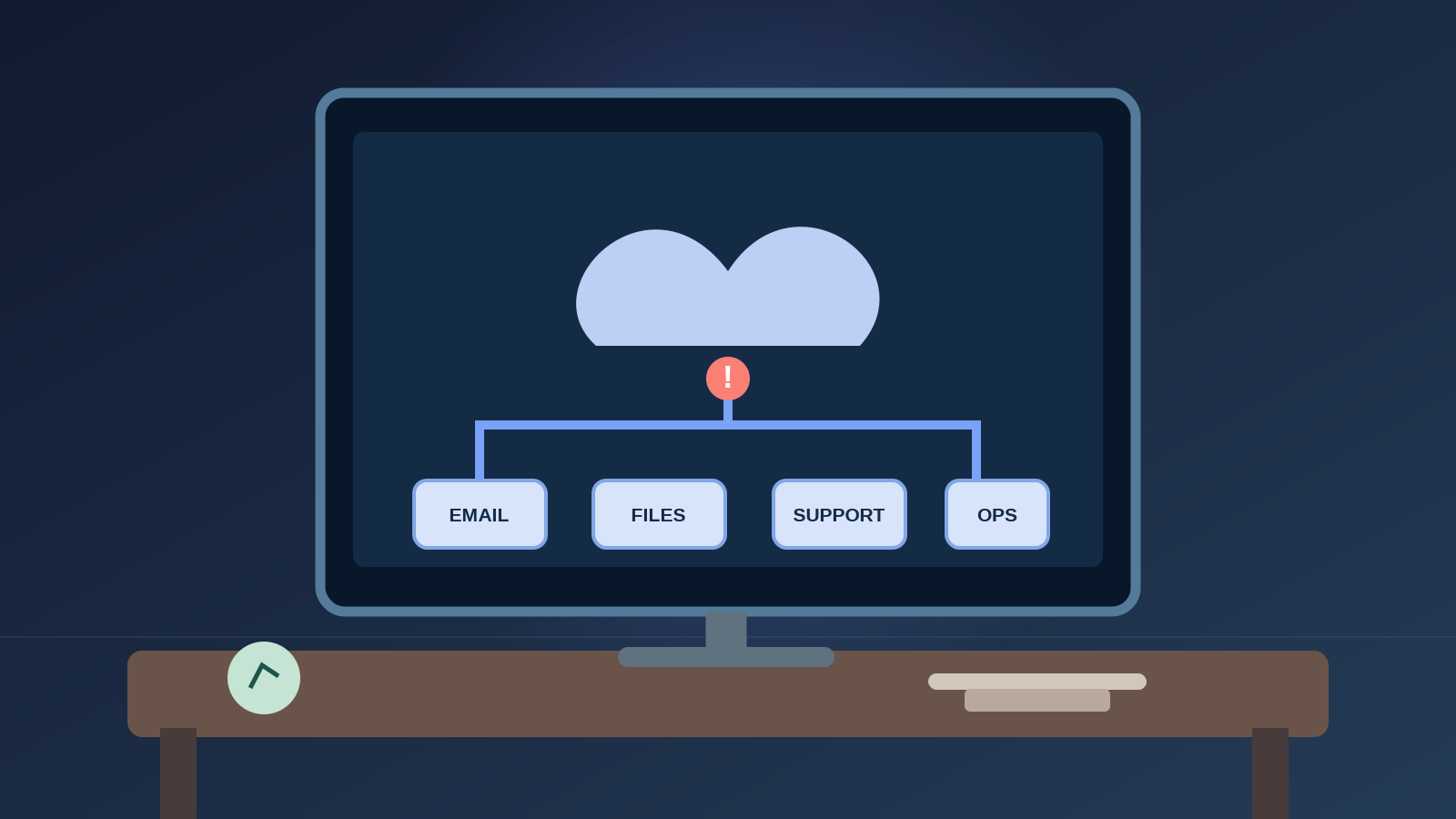
A major platform outage is not just a technology story. For a founder, it is a reminder that a convenient collection of software tools can quietly become one operating dependency.
Microsoft 365's November 2026 disruption provides a practical case study. The useful question is not whether a small company should abandon a particular vendor. It is how to identify the business functions that rely on one provider and decide which fallbacks are worth the cost.
What happened during the Microsoft 365 outage
On 12 November 2026, organizations around the world reported disruptions to Microsoft 365 services, particularly Outlook and Exchange Online. Microsoft Teams and other connected workplace tools were also affected. Independent monitoring by Cisco ThousandEyes observed timeouts, connection failures and HTTP errors beginning around 17:30 UTC on November 12. By 14:00 UTC on November 13, it reported that Outlook availability had largely recovered, while some users and locations continued to experience difficulties.
The distinction between an initial service recovery and the end of every user-facing symptom matters. An incident can improve on provider dashboards while individual accounts, queues and dependent systems remain unreliable. A responsible business continuity plan therefore has to describe what the company can actually do, not simply whether a status page looks green.
Reporting published on 16 November described a combination of a pre-existing software defect, pressure on internal network connections and reduced server capacity. It is not evidence that every service in Microsoft's portfolio failed simultaneously, that there was a cyberattack, or that AI caused the outage. Nor is it evidence that a particular small company lost a stated amount of revenue. Those claims would require separate records.
The event is useful precisely because Microsoft 365 is not a fringe application. Its value lies in integration: email, calendars, files, identity, chat and collaboration share an environment that is relatively easy to administer. The same architecture creates concentrated operational exposure when a shared component stops responding.
Source trail: ThousandEyes incident analysis, 16 November reporting and institutional service updates.
Why convenience accumulates into concentration risk
A founder usually does not set out to design a fragile operating system. They make a series of sensible purchases. One vendor handles company email; its calendar is included; files move into the same suite; employees sign in through the same identity provider; notifications, support tools and automations are connected. Each individual decision reduces friction, but collectively they may produce a single point of failure: one dependency whose loss prevents an important business outcome.
A single point of failure is not always a single machine. It may be a provider account, a domain registration, an administrator credential, an API gateway, a billing relationship, a DNS setting, a payment processor or a person who alone knows the recovery procedure. Redundancy between two apps is ineffective if both depend on the same authentication service or the same administrator mailbox.
Founder risk has three dimensions. Concentration asks how many workflows share one dependency. Recoverability asks whether the business can continue or recover without that dependency. Visibility asks how quickly someone can tell what has failed. A risk register that names only vendor brands will miss important shared services underneath them.
Vendor lock-in is a related but separate issue. The inability to export records or migrate workflows raises switching costs over months. A single point of failure may take a business offline in minutes. A product can be portable yet unavailable, or reliable day-to-day yet hard to leave. Founders should measure both rather than treating the terms as interchangeable.
Map critical workflows before buying fallback tools
Start with business outcomes, not software subscriptions. Write down five to eight workflows that must function for customers, employees or suppliers to make progress. A small digital business might include customer enquiries, payments, delivery or provisioning, access to files, and support. A service company may add booking, dispatch and staff coordination. For each workflow, trace the actual path from the first trigger to confirmation.
For customer support, a path could be: customer sends a message → mailbox receives it → team logs in → ticket is created → answer is sent → customer receives confirmation. That chain may appear to involve several tools but still share a single identity or mail provider. For checkout, a working storefront is not enough if the payment authorization, fraud check or post-purchase fulfillment step is unavailable.
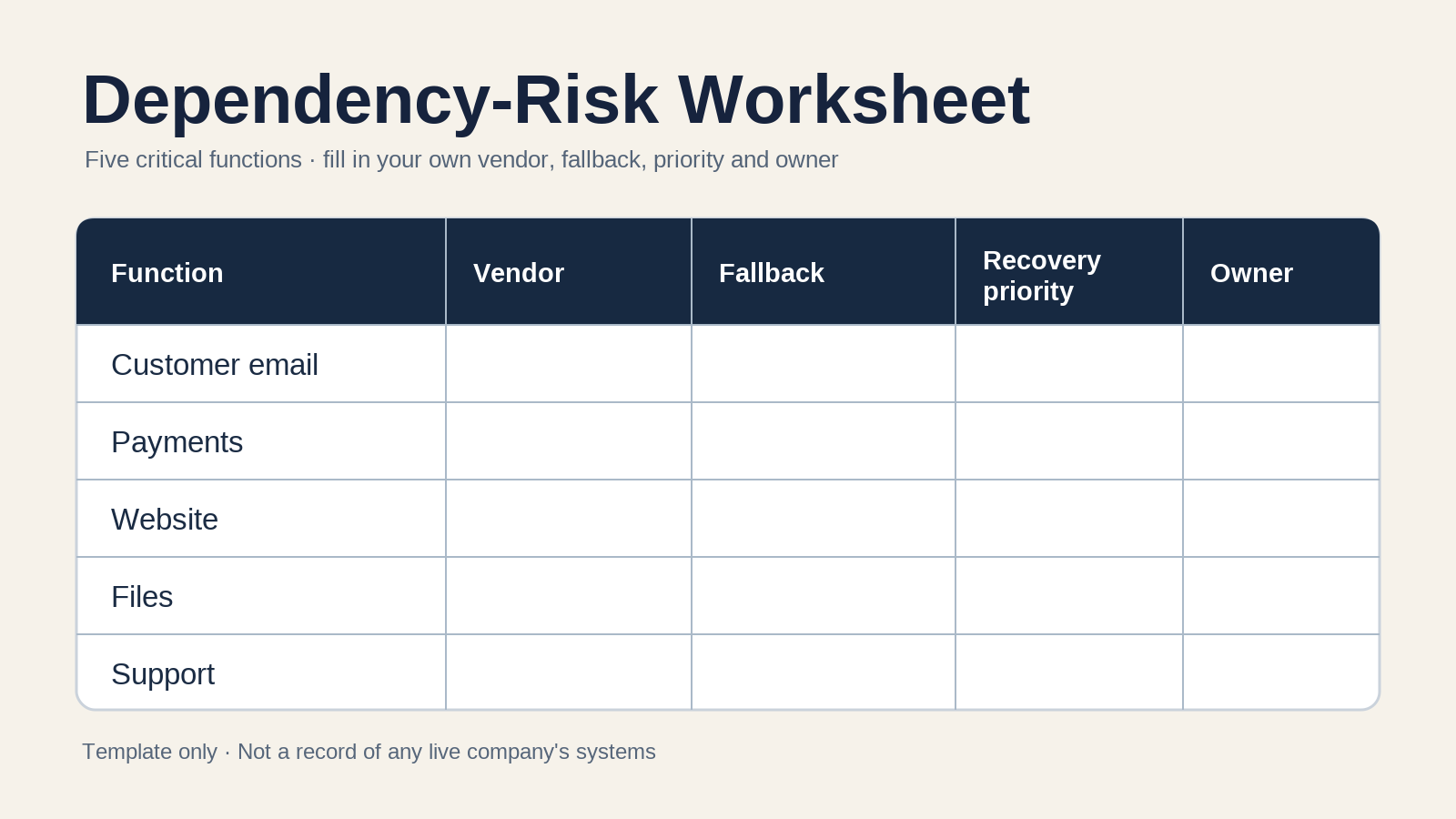
Record five fields: function, primary vendor, workable fallback, recovery priority, and named owner. Do not fill the worksheet with vendor promises. Describe the precise action someone can perform when the primary route stops. “Use another email service” is a vague fallback; “publish the verified support-contact update through an independently authenticated status page” is a testable step.
Be careful with sensitive data. A fallback should not involve emailing customer databases to personal accounts or copying secrets into an unapproved workspace. Operational continuity does not justify weakening privacy, access controls or audit trails.
Diversification versus complexity: the economic trade-off
The obvious reaction to an outage is to buy two of everything. For most small companies, this is bad economics. A duplicate CRM requires synchronization, staff training and a second permission model. A second payment gateway may introduce reconciliation and fraud complications. A standby application that nobody tests can create a false feeling of resilience.
Instead, compare the expected cost of disruption with the full annual cost of a fallback. The first includes lost contribution margin, missed commitments, recovery labor, contractual obligations and reputational harm when measurable. The second includes subscriptions, integration maintenance, training, monitoring, security reviews and the staff time required to test the backup. Both sides are uncertain; record ranges and assumptions rather than inventing a definitive return on investment.
The most economical fallbacks often preserve an essential outcome rather than duplicating the entire service. If team chat fails, a pre-agreed phone tree may allow urgent coordination. If the normal help desk fails, a public status update and a separately operated intake channel may reduce customer confusion. If a reporting dashboard fails, a securely exported daily snapshot may preserve the ability to make a key decision.
There are exceptions. A regulated service, high-volume transaction platform or time-critical healthcare workflow may justify deeper investment because the consequences of failure are materially greater. The right resilience level follows the impact and recovery obligation—not a generic technology checklist.
| Workflow | Low-complexity fallback | When deeper redundancy may be justified |
|---|---|---|
| Internal coordination | Independent emergency contact route | Dispatch or safety-critical work |
| Customer communications | Status page and alternate verified intake | Strict response commitments |
| Files and documentation | Scheduled encrypted exports with access checks | Continuous document access requirements |
| Payments | Order queue and customer messaging | Material transaction losses during outages |
A lightweight founder vendor-dependency review
The review can fit into one working session and should be repeated after significant platform changes. It is not a certification or a promise of zero downtime. Its purpose is to reveal the few dependencies worth acting on.
- Identify critical customer promises. Which actions must still be possible in the first hour, first day and first week of a disruption?
- Draw the dependency chain. Include domain, DNS, hosting, identity, billing, APIs, integrations, administrators and communication channels where relevant.
- Mark correlated failures. Two applications are not independent when they rely on the same login, cloud region or upstream provider.
- Assign impact and recovery priority. Use customer and financial consequences, not vendor popularity, to determine the order.
- Define one minimal fallback per critical outcome. Specify the trigger, who decides, what instructions users see and how normal operations resume.
- Test one realistic failure. Revoke access in a safe test account, disconnect a non-production integration or run a tabletop exercise without harming live customers.
- Record the result. Capture elapsed time, missing permissions, confused handoffs, stale exports and the next action owner.
A founder should particularly inspect the recovery bootstrap problem. If passwords, MFA recovery codes, billing alerts and incident messages all depend on one company email account, losing that account can make restoration harder. Secure offline emergency instructions and administrator access procedures may be more valuable than another premium dashboard.
Keep the review small. One page with dependencies, an owner and a tested action beats a fifty-page plan nobody opens during a real incident. Name who can authorize an emergency change when the founder is unavailable.
What evidence justifies deeper resilience investment?
Some founders will eventually need multi-provider failover, replicated data, alternate identity, contractual recovery commitments and incident response monitoring. They should invest when evidence supports the additional operational burden.
Useful triggers include repeated material service interruptions, increasing recovery time, customers with enforceable service-level requirements, a growing concentration of revenue in one affected workflow, regulatory obligations, or failed tabletop exercises. A pilot that shows the backup cannot actually receive a new order is an important finding; it is more actionable than speculation about a future outage.
For each proposed investment, define a measurable target. For example: maintain access to a verified customer-notification channel within a specified recovery window; restore the latest encrypted order export within an agreed tolerance; or let two authorized people complete an emergency sign-in. The chosen target should follow the business's needs, not an arbitrary industry benchmark.
Use recovery time objective (how quickly a function should return) and recovery point objective (how much data loss is tolerable) as decision tools. These are internal planning targets, not claims that a SaaS vendor will meet them. Written targets expose conflicts between customer commitments, architecture and budget.
The founder decision is about acceptable dependence
The lesson of the November outage is not that software ecosystems are inherently a mistake. Integrated platforms can be more secure, cheaper and easier to operate than a patchwork of poorly maintained substitutes. The lesson is that the convenience has a dependency price, and a founder should understand that price before an incident forces the question.
Choose the workflows that matter, map the dependencies honestly, test the cheapest credible fallback and invest further only when the evidence warrants it. The objective is not to eliminate every failure mode. It is to keep a temporary supplier problem from becoming an avoidable company-wide operational crisis.
For more practical analysis of building, operating and evaluating digital businesses, explore the founder journal or the wider portfolio.