
On October 7, 2026, Microsoft outlined a future in which artificial intelligence is more deeply integrated into Windows, its devices and the software people use for work. The announcements covered the Surface Laptop Ultra, NVIDIA RTX Spark, local and cloud computing, AI agents and the controls intended to make those agents safer. The technology matters, but for entrepreneurs the more useful question is commercial: what should you actually build, buy or change as a result?
Most small companies do not need a new AI workstation. They need fewer missed customer inquiries, faster quoting, clearer records and a way to deliver reliable work without adding unnecessary complexity. Microsoft's direction makes some of those solutions more feasible; it does not make every automated business model profitable.
What did Microsoft announce in October 2026?
Microsoft described Windows as a platform for hybrid intelligence, where suitable tasks can run on the local computer while more demanding work can access cloud models. It also opened pre-orders for commercial configurations of Surface Laptop Ultra, powered by NVIDIA RTX Spark, and discussed new local AI hardware and developer capabilities.
There was a significant security component. Microsoft said Microsoft Execution Containers (MXC) became generally available, providing policy-based boundaries around what AI workloads can access. By contrast, some Copilot experiences and agent identity and management integrations were described as upcoming or dependent on deployment. An announcement is not the same as immediate universal availability. See Microsoft's Windows overview and MXC developer article for the precise distinctions.
For business owners, three ideas matter more than the hardware specifications: AI can operate across a workflow, processing can be divided between device and cloud, and agent permissions must be explicit. None of these removes the need for testing, human accountability or a viable customer proposition.
Why AI agents matter to entrepreneurs
An AI agent is software that can pursue an assigned task by using tools, accessing approved information and taking actions within defined limits. It differs from a chatbot that mainly answers questions. An assistant may help draft an email; fixed workflow automation follows predefined triggers; an agent may examine the customer's request, identify a next step, retrieve a record and prepare a response for approval.
Consider a home-services company. An incoming enquiry might be classified, matched with a service category, recorded in a CRM and turned into a draft quote. A staff member would still approve pricing and any customer-facing commitment. That is a controlled AI-assisted workflow, not a reason to delegate unlimited access to the company's systems.
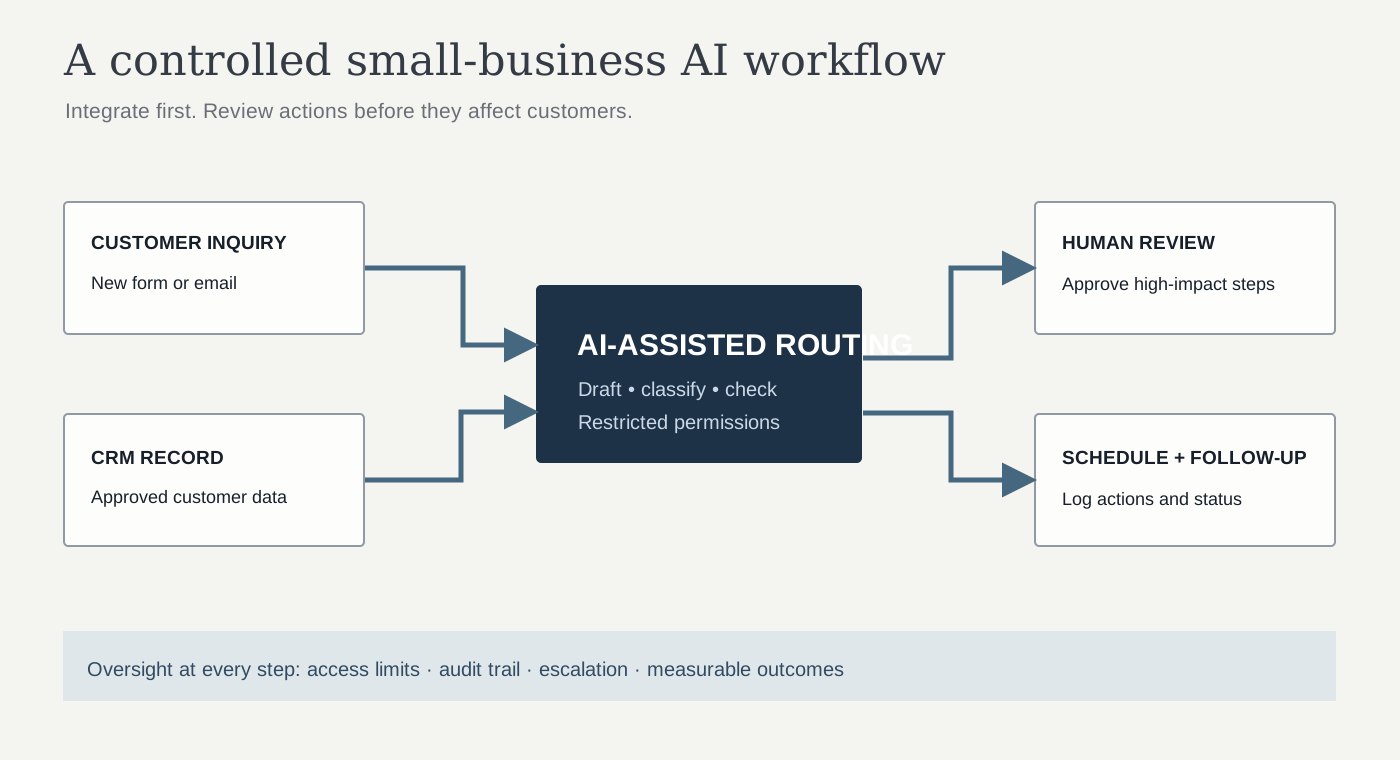
For founders, the opportunity is not simply to deploy agents. It is to package a dependable outcome: fewer administrative hours, better response consistency or more complete records. Reliability, access permissions, exception handling and ongoing operating costs determine whether that outcome is valuable.
From using AI tools to building AI-powered businesses
Using AI personally and selling an AI-powered service are different disciplines. A founder may use a model to draft product copy today. Building a product that dozens of clients depend on requires authentication, permissions, billing, monitoring, support, data handling and a plan for failures.
There are practical ways to cross that gap. Existing software can add a narrowly scoped AI feature, such as summarizing field notes or extracting candidate skills. An agency can offer a managed service that combines staff oversight with AI-assisted production. A software business can create a subscription product around a repeatable workflow. Industry-specific systems can integrate familiar terminology, documents and approval steps rather than providing an empty generic chat window.
Not every useful feature needs an autonomous agent. A simple rule, search feature or well-designed form may solve the problem more cheaply and reliably.
Seven AI business opportunities worth evaluating in 2026
The following are business models to validate, not predictions of revenue or guaranteed market demand. Each works only when a distinct group of customers values the result enough to pay for it.
1. Industry-specific AI software
Problem and customers: construction managers, property teams and specialist operators often work across disconnected forms, messages and documents. Revenue: a license per business, seat or site. Implementation: role-based access, domain-specific records, audit logs and careful document retrieval. Challenge and risk: incumbent software and incorrect outputs. Validate: whether users will replace an existing step in their workflow and pay for the time saved.
2. AI-assisted CRM systems
Problem and customers: service businesses lose track of leads and follow-ups. Revenue: monthly SaaS or managed CRM fees. Implementation: contact records, pipeline stages, integrations and approved message drafts. Challenge and risk: crowded CRM competition, privacy and inaccurate automatic updates. Validate: higher follow-up completion and genuine usage, not the number of AI buttons available.
3. AI automation for service businesses
Problem and customers: trades, clinics and local agencies handle repetitive booking, enquiry and document work. Revenue: setup plus monthly maintenance. Implementation: process mapping, scheduling connections, exception queues and human escalation. Challenge and risk: brittle integrations and sensitive customer data. Validate: volume of repetitive tasks, cost per transaction and the owner's appetite for operational change.
4. AI-powered marketing and content operations
Problem and customers: small brands need campaign planning, copy variations and consistent reporting. Revenue: subscriptions or agency retainers. Implementation: brand guidelines, editorial approval, platform data connections and performance measurement. Challenge and risk: interchangeable outputs, platform policies and unreliable attribution. Validate: whether customers value the full production workflow more than free AI writing tools.
5. Specialist AI for professional industries
Problem and customers: legal, finance, recruitment and healthcare teams need structured information retrieval and document support. Revenue: organizational licensing or managed deployments. Implementation: verified sources, strict access control and review by qualified professionals. Challenge and risk: regulatory exposure and harmful factual errors. Validate: a narrowly defined, low-risk task before attempting high-stakes recommendations.
6. AI-enabled ecommerce operations
Problem and customers: ecommerce merchants need product enrichment, support triage and inventory insights. Revenue: application subscription, usage fee or store-management service. Implementation: storefront and order integrations, catalog quality checks and customer-support boundaries. Challenge and risk: incorrect product claims, refunds and thin margins. Validate: measurable operational improvement on a real catalog.
7. White-label and subscription software
Problem and customers: agencies and entrepreneurs want to sell useful software without constructing every component. Revenue: license, recurring SaaS or setup-and-support fees. Implementation: secure multi-customer architecture, clear licenses, branding, billing and help desk. Challenge and risk: vendor dependence, commoditization and unexpected support costs. Validate: reseller rights, actual gross margin after ongoing expenses and whether end users will retain the product.
Why industry-specific AI may be more useful than generic AI
Vertical software solves a defined problem for a defined industry. A construction platform might organize site inspections and approvals. Recruitment software needs candidate stages, submissions and interview records. Real-estate systems need property and tenancy workflows. Field-service teams work with jobs, quotes and technician schedules. Ecommerce operations depend on accurate product and order data. Professional-services firms rely on controlled access to client information.
What these businesses share is context. A generic AI interface may be impressive, but it rarely includes the real fields, permissions and decisions of a working company. Specialist tools become useful when they understand the workflow and fit inside it. That is the type of business-software problem explored through NIR.Systems — without assuming AI should replace every existing process.
Specialization also raises responsibility. A product is not made safe merely by using industry vocabulary. Accurate data, testing, relevant permissions and human review remain essential.
Starting an AI company or adding AI to an existing one?
| Decision | New AI startup | Existing business + AI |
|---|---|---|
| Initial investment | Product, distribution and support from zero | Incremental feature and integration costs |
| Customer acquisition | Must establish trust and reach | Can test with current customers |
| Development complexity | Full platform and operations | Existing stack may constrain integration |
| Operational risk | Unproven demand plus technical risk | Risk to established workflows and reputation |
| Recurring revenue | Possible if retention is strong | May improve retention or support premium pricing |
| Maintenance | Complete product and infrastructure responsibility | Additional integration and model maintenance |
| Differentiation | Must build a defensible niche | Can extend existing customer knowledge |
If you already have customers and understand their friction points, adding a targeted feature is often the lower-risk experiment. A standalone startup is more appropriate when the pain is urgent, customers lack a good alternative and you can reach that audience repeatedly.
Building vs buying vs white-labeling AI software
Custom development gives the most control over design and workflows, but requires engineering ownership, updates and support. Buying an established application can save initial development time; evaluate contract terms, transfer rights, code access and dependency risks. White-label licensing may speed up launch, but branding permissions and customer rights are defined by the license, not by what the sales page suggests.
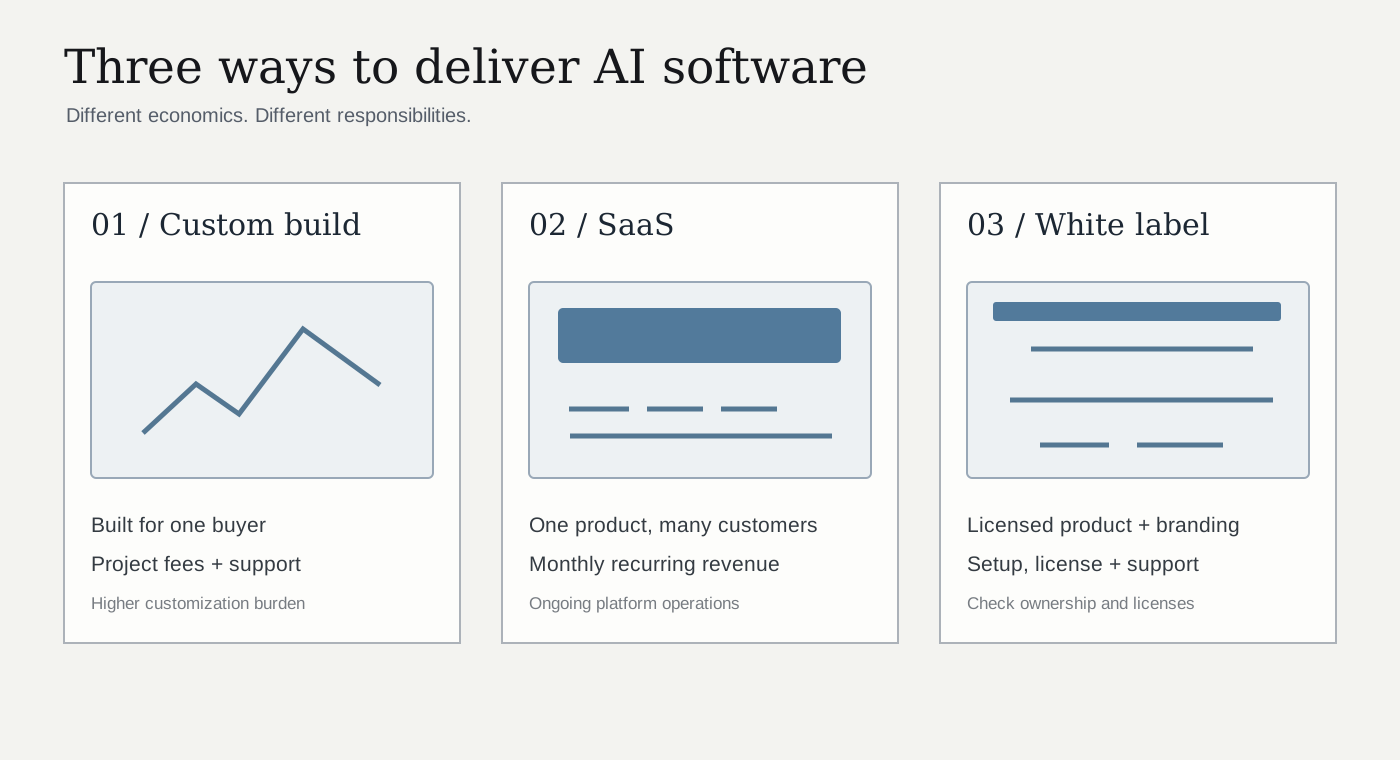
Open-source development can reduce licensing dependence but still requires security, hosting and maintenance. A SaaS subscription moves much of the platform responsibility to a provider, while a managed service combines the application with hands-on configuration and customer support. These models can also be mixed.
Before choosing, document who owns the data, who may export it, which party runs hosting, whether the software can be resold, who resolves support tickets, and how ongoing model and infrastructure costs will be paid. Purchasing a license does not automatically transfer ownership of the source code.
Ready-made digital businesses, such as those offered through EcomChief, illustrate why the handover and operating model matter as much as the initial product. The sustainable offer is a functioning business process, not merely a website or AI interface.
What Microsoft's local AI strategy means for small businesses
Local AI performs at least some computation on a device the business controls. Cloud AI uses remote computing resources. A hybrid approach routes work between them according to task, performance, cost and data requirements.
Local processing may reduce repeated cloud requests and support some offline scenarios. It can also demand expensive hardware, create management work and limit which models run effectively. Cloud services may offer easier updates and access to more capable models, but create ongoing usage charges, connectivity dependence and data-processing considerations. Hybrid architecture adds flexibility while introducing another layer of design and administration.
Microsoft's Surface Laptop Ultra pre-orders highlight how costly high-performance local AI can be. For many small businesses, a browser-based tool or modest cloud subscription is a more sensible starting point than specialist equipment. Compare total cost of ownership rather than assuming local is always faster, cheaper or safer.
Five mistakes entrepreneurs should avoid
- Buying technology before defining a problem. Write down the task, who does it and what an improvement would be worth.
- Ignoring recurring costs. Include models, hosting, APIs, development, monitoring and customer support in the economics.
- Giving agents excessive access. Start with least-privilege permissions, approval checkpoints and activity logs.
- Assuming outputs are correct. Test against real edge cases and require review for financial, legal, personal or customer-impacting decisions.
- Building before validating demand. Interview users, test a paid pilot and observe whether people actually change their routine.
My approach to evaluating AI business opportunities
When I think about practical digital entrepreneurship, I prefer to start with a business problem rather than a technology label. The relevant questions are simple: What does the customer struggle with? Will they pay to solve it? Can they understand the product quickly? Can it be delivered and supported affordably? Why would they choose it over an established alternative?
For ecommerce, that might mean a simpler way to launch and operate a store. For specialist software, it might mean organizing the work of a trade or professional team. For digital design, it might mean making a complex service feel clear and usable. Those are useful lenses across work such as Depiction Studio, NIR.Systems and EcomChief, rather than claims about a particular customer's results.
A viable opportunity needs a path to repeatable revenue and a realistic plan for long-term support. AI can reduce parts of the build process. It cannot eliminate the commercial obligation to deliver something customers trust.
A practical five-step AI adoption roadmap
- Identify one costly or repetitive task. Interview the person doing the work and record a baseline.
- Estimate the benefit and full cost. Include staff time, software charges, human review and failure-handling effort.
- Run a small controlled pilot. Use a narrow workflow, limited data and explicit sign-off.
- Measure reliability and customer outcomes. Track turnaround time, corrections, exceptions, cost per completed task and user satisfaction.
- Expand only when evidence supports it. Add access, automation and new customers gradually, with a recovery process in place.
Frequently asked questions
What are AI agents?
AI agents are programs that can use approved tools and information to carry out a task, sometimes across several steps. Their actions still need boundaries and oversight.
How can entrepreneurs use AI agents?
Start with controlled tasks such as lead triage, drafting CRM updates, preparing quotes for approval and summarizing documents. Test the accuracy and operating cost first.
What is hybrid AI?
Hybrid AI combines local processing on a device with cloud computing, selecting an appropriate resource for different tasks.
Can a small business afford AI automation?
Often, yes, when a focused subscription or pilot produces enough value. The cost depends on usage, integrations, hardware and support. Expensive local systems are not always required.
What are the best AI business opportunities in 2026?
Promising areas to investigate include industry-specific software, CRM assistance, service workflow automation and ecommerce operations. The best option depends on verified customer demand and distribution.
Can you start an AI business without being a developer?
Yes, founders can use low-code tools, vendors or technical collaborators, but they remain responsible for product decisions, security, service delivery and commercial viability.
What is white-label AI software?
Software licensed for resale under another business's branding, subject to the exact contract. White labeling does not automatically confer source-code ownership.
Is it better to build or buy AI software?
Build when a unique workflow justifies technical ownership; buy when speed and reliability matter more; license when legitimate resale rights and margins fit the model.
What are the main risks of AI-powered businesses?
Inaccurate outputs, data exposure, permission errors, recurring costs, vendor dependency, unreliable integrations and insufficient customer demand.
The opportunity is the problem you solve
Microsoft's October 2026 announcements illustrate where personal computing and AI software are heading: more capable local models, more flexible cloud integration and better-defined controls for agent activity. They do not remove the hard part of entrepreneurship — finding demand, earning trust and delivering consistent results.
The most important business opportunity is not simply using the newest AI technology. It is identifying a real business problem and building a solution customers find valuable.
That is the standard I would use before committing to a new AI-powered business, adding automation to an existing company or buying the next impressive tool.