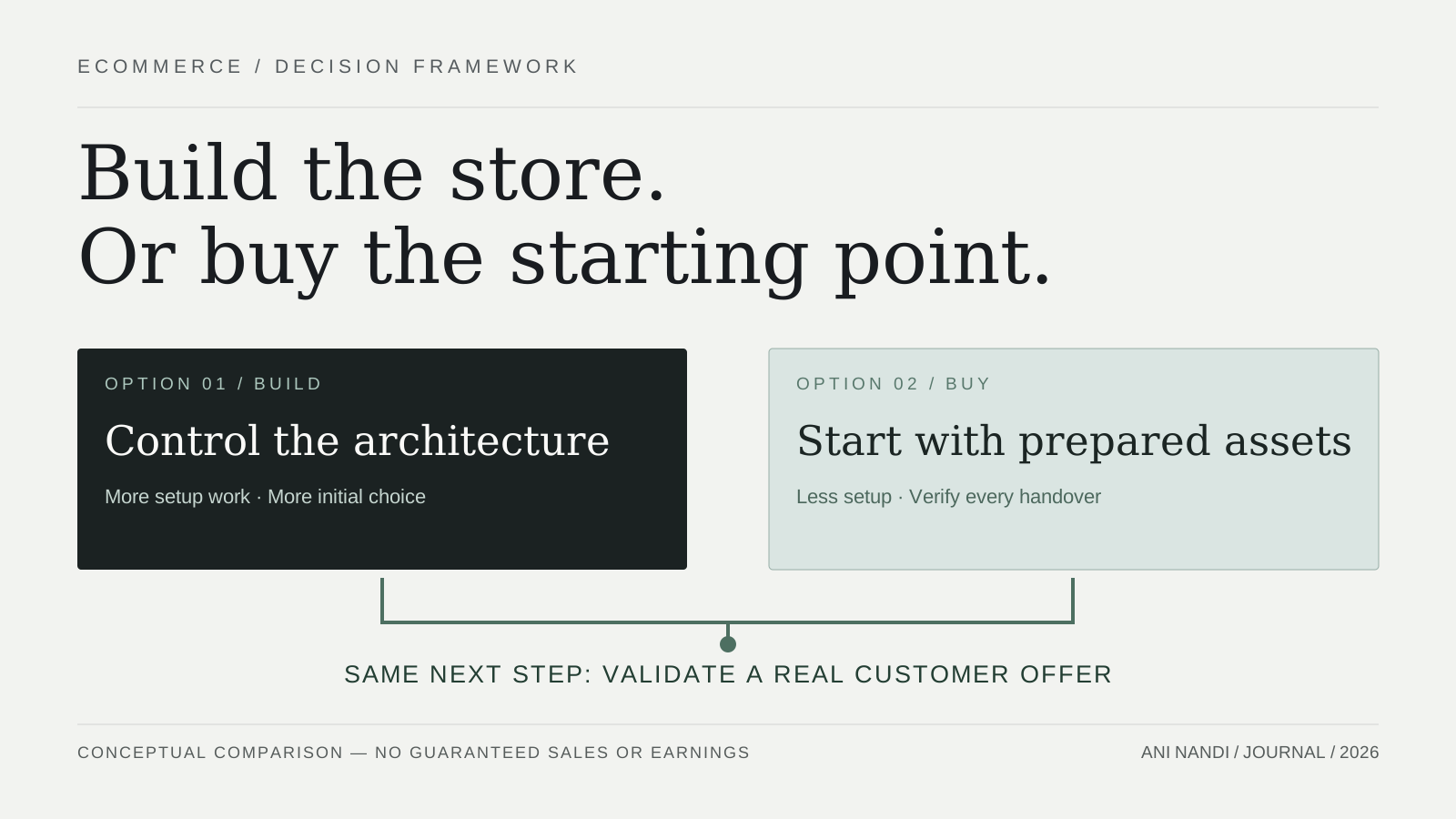
The first ecommerce decision is often presented as a website decision: build your own Shopify store or buy one that someone else has already prepared. In practice, it is a decision about where you invest scarce time, what you own and how quickly you can test demand.
I work with ready-made digital businesses, and I also know what it takes to assemble and check ecommerce storefronts. That gives me reasons to see the appeal of buying—but also a reason to be clear about its limitations. A completed website is a starting asset, not a customer acquisition strategy or evidence of profit.
Two different ways to reach the same starting line
When someone tells me they want to start an ecommerce business, I ask what they actually need to buy: a finished website, a repeatable way to acquire customers, or an established business with trading history. Those are three different things. Confusing them leads to bad comparisons.
Building a Shopify store means choosing the niche, designing the storefront, preparing products, configuring the platform and validating the buying experience yourself or with hired help. Buying a ready-made Shopify store generally means acquiring a prepared storefront and its agreed digital assets so you can begin from a more complete technical starting point. Acquiring an operating ecommerce business is another category entirely: you are evaluating existing operations, financial records, liabilities and customer relationships, not just a website.
The right choice is not automatically the cheapest or fastest path. It is the path that gets you to a testable customer offer with an acceptable level of control, expenditure and risk. A prepared store can save setup effort. It cannot substitute for demand, marketing discipline or commercial judgment.
Build, buy a starter, or acquire an established business?
I separate the options before comparing prices. A new Shopify build starts with a mostly blank canvas. A prepared starter usually already has design, product pages and some initial configuration. An established operating business may have customers, supplier terms, traffic history and liabilities—assets and obligations that require far deeper diligence.
| Question | Build from scratch | Buy a prepared starter | Buy an operating business |
|---|---|---|---|
| What is acquired? | Services, platform account and work you create | Agreed store, design, content and setup assets | Potentially a trading operation plus assets and obligations |
| Launch preparation | Most setup remains to be done | Some setup may be supplied, subject to QA | Existing workflows may transfer, but need validation |
| Historical revenue | None by default | None implied by the word “ready-made” | May exist, but must be independently verified |
| Customization | Maximum initial choice | Limited by what you buy and can change | Changes may disrupt established performance |
| Primary diligence | Scope, costs, functionality and legal readiness | Assets, rights, transfer and checkout readiness | Financials, liabilities, traffic, operations and transfer |
This distinction matters when comparing a low-cost prepared store to a multi-thousand-dollar business listing. They are not the same product at different prices. Their underlying evidence and risks are different. Shopify's guide to buying a business treats financial records, valuation and due diligence as central to an operating-business acquisition.
The strongest reason to build: you control the starting assumptions
Building from scratch is especially attractive when you have a differentiated product, clear customer research, established brand standards or a fulfillment arrangement that does not fit a generic catalog. You decide the information architecture, product assortment, visual hierarchy and integrations before anyone has made compromises on your behalf.
You also learn the system while assembling it. That knowledge can make future changes easier. For example, if you personally configure shipping markets, product variants and tax settings, you understand why an order behaves a particular way. The educational value is real, but it costs attention and time.
The opposite of control is not necessarily speed. A founder can spend weeks perfecting a header, comparing themes and selecting apps while remaining uncertain whether customers want the product. I would build from scratch when the differentiation matters enough to justify that effort. I would not automatically build from scratch just to feel that every pixel is original.
The strongest reason to buy ready-made: you can remove setup friction
A prepared store may already contain a branded interface, initial product pages, basic supplier connections and a set of supporting assets. For a first-time operator who has limited interest in design or Shopify administration, that can remove a meaningful block of mechanical work. Instead of starting with an empty theme, the owner can inspect a functioning candidate and decide what needs correction.
I operate EcomChief's ready-made ecommerce store collection, where public listings currently advertise prepared dropshipping storefronts from $99. That is an example of the category, not evidence that a $99 purchase includes an audience, profitable orders or a transferable operating history. Availability, the exact deliverables and any optional package should be checked on the current listing before purchase.
Buying is strongest when the supplied assets are actually reusable for the buyer's intended market. A polished catalog in the wrong niche or with poor supplier economics may create more work than a focused new build. The best prepared store is not simply the one with the most products. It is the one you can understand, operate, improve and test without rebuilding its foundations.
Compare the whole cost, not only the invoice
It is tempting to frame the decision as “free Shopify theme versus $99 store.” That ignores the cost of time, a domain, subscription fees, paid apps, supplier fees, testing and acquiring customers. Conversely, it is misleading to compare a professionally custom-built store costing thousands with a basic prepared template as if they delivered identical scope.
As checked on 31 October 2026, Shopify's public US pricing page shows Basic at $39 per month when paid monthly, or $29 per month on annual billing. Shopify also advertises a trial and introductory offers, which may change and depend on eligibility. Plan pricing can differ by country; fees for payment processing and third-party apps are separate considerations. A ready-made starter does not remove the underlying platform subscription.
| Cost or task | Build yourself | Buy prepared starter |
|---|---|---|
| Initial storefront work | Mostly your time, or a separately quoted developer | Covered only to the extent the listing specifies |
| Starter asset price | No purchase of a completed store; time is not free | Seller's listed one-time price, if applicable |
| Shopify plan | Ongoing | Ongoing |
| Domain and renewal | Verify purchase and renewal terms | Verify domain inclusion and who controls renewal |
| Apps, suppliers and fulfillment | Configure, pay and test as needed | Audit included apps, credentials and recurring charges |
| Advertising and creative testing | Separate operating budget | Separate operating budget |
| Returns, chargebacks and customer support | Your operating responsibility | Your operating responsibility |
My practical comparison uses a first-90-days total cash and time budget: one-time acquisition or build services, platform charges, domains, apps, product samples, basic creative work and a controlled acquisition test. There is no universal dollar estimate because a free-theme experiment, paid custom build and prepared starter have very different scopes. The correct total is the one calculated from your actual planned stack.
Time saved is valuable only if it moves you toward validation
Buying a prepared store can shorten the website setup portion of a launch. But “ready to launch” is not the same as “ready to acquire customers economically.” If the owner has not selected a viable audience, confirmed shipping coverage or decided how to produce qualified traffic, a quicker handover merely moves that uncertainty to an earlier date.
There is also a common founder error on the build side: endlessly refining a website because the work is visible and controllable. A finished storefront can feel like progress even while customer demand remains untested. I prefer to define what the first acquisition experiment must learn before deciding how much development is warranted.
Whether the site is built or purchased, I would want a concrete first test: a narrow product group, a clearly defined customer segment, validated checkout, accurate landed costs and an affordable way to measure visits, add-to-cart behavior and actual orders. That is operational progress. The number of installed apps is not.
Ownership means more than receiving an admin login
A seller can invite someone to a store without transferring ownership. A buyer should know which is happening. Shopify documents formal store ownership changes and transfers, including owner acceptance, billing considerations, domain information, and updates to payment and payout details. It also distinguishes collaboration access from store ownership.
For a prepared store, I would ask for an itemized handover: the exact Shopify store, the custom domain and registrar access where included, who owns creative assets and product descriptions, what theme or app licenses permit, supplier account arrangements, what billing charges remain, and which credentials must be replaced. Never assume that access to a theme, app or supplier account automatically means every associated license or relationship is transferable.
Payments deserve separate attention. The buyer must activate or update appropriate payment accounts with their own business and banking details. Shopify Payments is restricted by country, business type and product eligibility. A ready-made checkout design does not mean a specific payment method is approved for the new owner. That distinction protects both buyer and seller.
Product and supplier quality matter more than catalog size
A store with hundreds of imported products may appear substantial. A store with twenty coherent, deliverable products and accurate product data may be easier to launch and manage. I look for the relationship between the customer promise, supplier capabilities and product presentation.
In Shopify catalog work, import errors have surfaced around variant option values. That is a useful technical warning: a CSV that looks complete can still violate the platform's product structure. The issue is not solved by adding another hundred descriptions. It is solved by matching every variant to its declared options, checking product handles and confirming the collections that the storefront expects to display.
Supplier checks are equally important. Are shipping origin and transit estimates defensible? Can the supplier fulfill the chosen product variants? What happens if stock changes or an item arrives damaged? Are advertised product claims or brand assets permissible? Whether you build or buy, a supplier catalog is not proof of stock accuracy or a binding service-level commitment. Check supplier terms and place appropriate sample or test orders before scaling promotions.
Technical readiness is a checklist, not a promise
The minimum acceptance standard should be the same for a fresh build and a purchased starter. A real customer must be able to understand the offer, complete checkout using an available payment method, receive accurate shipping and return information, and contact the merchant when something goes wrong.
Shopify's launch guidance recommends test orders to verify checkout, processing, inventory, shipping and taxes. I would add visible checks for mobile navigation, product variants, cart changes, required policy pages, email notifications, domain configuration, analytics consent where applicable, and payment-country eligibility. Testing on the seller's account is not a substitute for testing after ownership and payment settings change.
For a more detailed operational checklist, I have written separately about what I check before a Shopify store goes live. The build-versus-buy decision is upstream of that. Whichever route you choose, the launch gate remains your responsibility.
Be careful with claims about traffic, margins and automation
A store can contain marketing templates, social creative ideas, SEO articles or an advertising guide. Those assets may save preparation work; they are not an audience. A traffic package should be assessed for relevance, acquisition source, actual human engagement and whether it generates qualified buyers rather than counts that look good on a dashboard.
Similarly, a configured product markup is not a net profit margin. Supplier price, shipping, payment fees, refunds, chargebacks, discounts, taxes, advertising and customer service can materially change unit economics. I would calculate contribution after variable costs before treating any product as commercially viable.
Automation also needs a precise definition. Some apps can synchronize products or forward orders, but those functions depend on the integration, plan, permissions and supplier. “Automated store” should not mean the owner can ignore fulfillment exceptions, disputes, regulatory responsibilities or product quality. No credible seller can guarantee that a completed storefront will generate sales merely because it exists.
A more useful decision matrix
I would not recommend one answer to every founder. The best option depends on the work they are equipped to do and the uncertainty they need to resolve.
| Your situation | Likely better starting choice | Reason |
|---|---|---|
| Distinctive physical product or complex logistics | Build to fit the product | Brand, fulfillment and data requirements shape architecture |
| Simple catalog, little interest in store setup | Consider a vetted ready-made starter | Can reduce repetitive setup if assets match the market |
| Unclear niche or customer demand | Validate before either large commitment | Neither a theme nor a prepared store proves demand |
| Established company with technical integrations | Custom or carefully scoped development | Requirements, security and workflows are specific |
| Buying existing orders, customers and revenue | Operating-business acquisition diligence | Financial and legal review matters beyond the storefront |
| Marketing-focused founder with a modest test budget | Whichever preserves most budget for validated acquisition | Operating learning may matter more than extra design scope |
Notice that “buy” is not always the recommendation from someone who sells prepared stores. If a buyer needs a custom ordering flow, region-specific compliance or a genuinely differentiated product experience, a generic starter may be the wrong asset. I would rather see the decision made accurately than create a repair project that should never have been purchased.
My due-diligence questions before paying for a prepared store
I would want written answers to these questions before buying a starter asset. They turn an appealing listing into a reviewable scope of work.
- Exactly what transfers? A Shopify store, domain, product catalog, images, blogs, supplier connections and guides should be itemized, not implied.
- What are the continuing charges? Ask for the Shopify plan, paid apps, supplier subscriptions, domain renewal and payment fees.
- Can I inspect the actual storefront? Review its mobile pages, product details, cart, policies and collection consistency.
- Are the supplied assets legally reusable? Clarify theme rights, image licensing, branding and any third-party subscriptions.
- Who is the actual store owner after handover? The answer must involve a documented transfer, not merely collaborator access.
- Which payments work in my country? Determine eligibility and account verification before counting on a checkout.
- What evidence supports revenue or traffic claims? If none exists, treat the asset as a new venture with no operating history.
- What does support cover? Distinguish fixing delivery defects from promising ongoing marketing, fulfillment or sales.
I would also review any refund or final-sale terms, delivery timelines and acceptance criteria before purchasing. None of those steps makes a poor business idea good, but they reduce avoidable surprises about what has actually been sold.
A small validation test beats a premature commitment
When the niche is still uncertain, I prefer the least expensive credible test that can disprove the idea. Define one customer segment and a manageable product set. Confirm supplier terms, available shipping destinations and a realistic landed cost. Study competing offers and understand why your product deserves attention. Then choose the lowest-friction way to present the offer and measure genuine interest.
The success metric should not be “the store launched.” Depending on the business model, I would look for qualified visits, a functioning checkout, inquiries from real prospects, early orders, and what it costs to acquire and serve a customer. Use actual transaction data when available; a few add-to-carts do not prove profitable demand. If the acquisition test is inconclusive, refine the offer before spending heavily on another design.
For some founders that test will use a simple self-built Shopify theme. For others, a prepared starter may be the cheaper way to get into market. The test design matters more than the prestige of the build method.
The decision I would make as an operator
My recommendation is conditional but practical. Build when your product, brand or workflows require genuine customization and you can justify the time. Consider a ready-made starter when the offer is straightforward, the supplied assets are credible and the saved setup effort lets you spend more attention on validating demand. Acquire an established business only when you are prepared to analyze its financial and operational history.
Do not buy a new store expecting inherited revenue. Do not spend months building a storefront to avoid talking to customers. And do not equate a polished theme with a reliable ecommerce operation.
The real question is not “Should I build or buy a Shopify website?” It is “Which starting point leaves me with a testable offer, clear ownership, controlled costs and enough resources to learn whether customers will purchase?” That is the decision worth making before you pay for either route.
- Shopify pricing — US plan pricing checked 31 October 2026; promotions and regional rates can change.
- Shopify Help Center — Change or transfer ownership — store transfer, owner rights and handover considerations.
- Shopify Help Center — Preparing a store for launch — test orders and launch checks.
- Shopify Help Center — Payments eligibility — country, business type and product restrictions.
- Shopify — How to buy a business (2026) — how operating-business acquisitions differ from starter assets.
- EcomChief public ecommerce collection — example of a prepared starter-store listing; commercial reference owned by the author.
Editorial disclosure: I own EcomChief, which sells prepared digital businesses. This article distinguishes that offering from established revenue-producing acquisitions. Prices are observations from public listings, not offers guaranteed to remain available. No customer returns, conversion rates, earnings, or measured time savings are asserted.