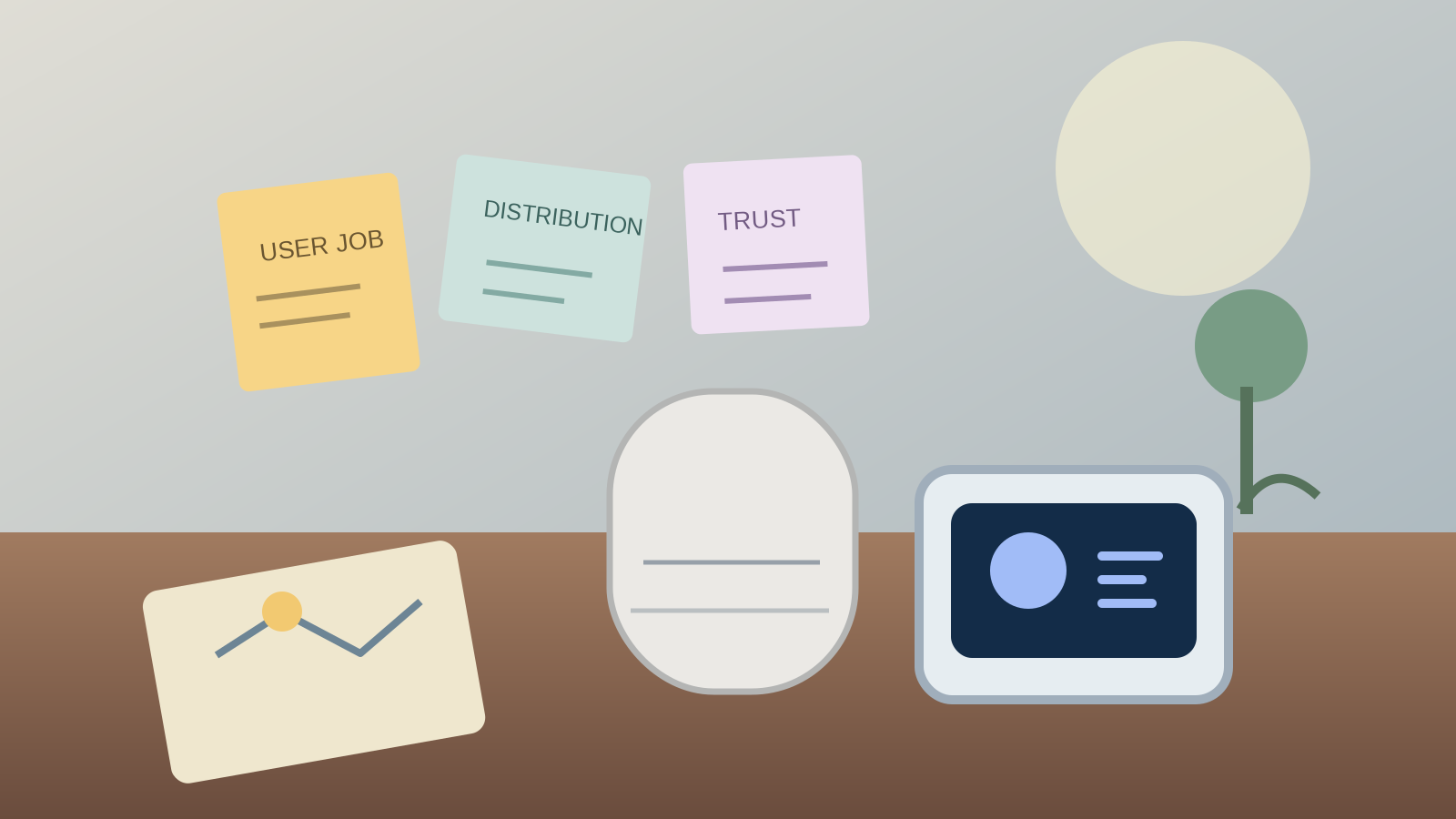
Apple HomeView is a timely reminder that AI product strategy is about the entire customer experience, not the model running behind it. Distribution, identity, interface, trust and ongoing use shape the advantage.
Independent founders have different constraints and different opportunities. The useful lesson from Apple's 2026 launch is not to imitate the hardware; it is to identify the aspects of a viable product that can be tested in a narrow market.
What Apple actually announced in October and November
On 13 October 2026, Apple introduced HomeView, a smart-home display designed to combine entertainment, household coordination and connected-home controls. Apple's announcement described a 7-inch Liquid Retina display, a tabletop model and a wall-mounted version, and a new Siri AI experience powered by Apple Intelligence. The company said HomeView can recognize household members and adapt personal content, and that more contextual features require a compatible paired device.
On 13 November, Apple published an availability update confirming that HomeView could be purchased in selected markets. Apple listed a US starting price of $299 for the tabletop and wall-mounted versions, with regional availability and feature restrictions. The announcement makes the product a current market example, not a rumor about an unannounced device.
Founders should distinguish announced capability from independently measured adoption. Product specifications, launch markets and privacy descriptions can be checked against Apple's materials. Active usage, household retention, total unit sales and customer satisfaction cannot be inferred from a product announcement or a spike in search activity. The latter metrics would require separate evidence.
The analysis below uses Apple as a strategy case study. It does not assume the average independent founder can replicate its installed hardware base, brand trust, distribution channels or technical integration.
Primary sources: Apple's 13 October announcement and Apple's 13 November availability update.
Hardware ecosystems and independent AI applications have different advantages
HomeView enters a context in which Apple already has devices, operating systems, a home-automation framework, retail reach, payment relationships and familiar consumer identities. The product can ask for a place in an existing household ecosystem rather than persuading customers to establish every relationship from scratch. That changes acquisition economics.
An independent AI software business usually starts from the opposite direction: no default position in the home, no preinstalled account, no automatic contact with customers, and little ability to influence the user's operating system. It can, however, move faster inside a narrow segment, support workflows that a general consumer platform overlooks, and adapt without manufacturing hardware.
This difference matters more than the size of the underlying AI model. A clever assistant is not necessarily a viable business when the user must open a separate app, grant permissions, explain context, verify outputs and maintain another subscription. The indie advantage often comes from solving a complete task with fewer handoffs, not from matching a platform's broad feature list.
Voice interface UX also needs context. Hands-free requests make sense when a person is cooking, carrying objects or moving around a room. A multi-field quotation, legal review or accounting reconciliation may work better with a visible screen, confirmations and an editable record. The interface should follow the work.
Lesson 1: Distribution is part of the product, not the launch campaign
A platform owner can introduce a feature through existing devices, software updates, in-store demonstrations and trusted accounts. An independent builder cannot simply assign that reach to a new product. Before developing an AI assistant, identify where the user already encounters the problem and what it will cost to interrupt that workflow.
A workable experiment is to recruit ten qualified users from one distribution channel and measure how many can complete the target task without a manual demonstration. Track acquisition source, activation and first useful outcome. If sign-ups require an elaborate founder explanation, that is evidence of a messaging or distribution problem—not necessarily a missing feature.
Falsifiable test: Can a clearly defined buyer discover the value proposition and obtain one useful result through a repeatable acquisition route? If not, reconsider the channel and the job before expanding product scope.
Lesson 2: A narrow, recurring job can beat a general-purpose assistant
HomeView groups everyday activities into a shared household environment: communication, personal information, entertainment and home controls. Apple has a rationale for breadth because it owns many of the connections. An indie founder usually needs the opposite focus.
Consider a field-service business that repeatedly turns a technician's notes and photos into a structured customer report. A specialized AI workflow could capture the evidence, draft the report, flag missing data, request human approval and deliver an auditable PDF. This is a sharper proposition than promising an assistant that will "run your business."
Define one job, one user, one trigger, one completed outcome and one exception path. Support for more jobs is justified when users demonstrate repeated success with the first. Avoid creating an apparent product by stitching together a chat box and several unfinished integrations.
Falsifiable test: During a two-week pilot, do users complete the specified workflow repeatedly, with fewer correction steps or less elapsed effort than their existing method? Capture both successful and failed attempts.
Lesson 3: The interface must earn trust before the AI earns autonomy
A household device has unusual trust demands: it may be shared by several people while handling personal calendars, messages, cameras and voice requests. Apple's announcements describe recognition and safeguards intended to separate private content, but an announcement is not independent proof that every real-world edge case will work flawlessly.
The broader lesson for software founders is to design permissions, explanations, approval points and error recovery before encouraging hands-free actions. Users need to know what the assistant can see, what it has changed, which output is uncertain and how to reverse a mistake. For sensitive actions, the user should have a clear confirmation step.
Privacy is not an aesthetic feature. It includes access boundaries, data retention, third-party API disclosures, deletion mechanisms and operational monitoring. A vertical AI product that can reach customer records must be especially explicit about who may access that information and under what conditions.
Falsifiable test: Ask pilot users to complete a sensitive operation and then accurately explain what data was used, what action was taken and how to correct it. Confusion is a product defect even when the AI generated a plausible answer.
Lesson 4: Retention depends on completing the task, not novelty
A product announcement and attention spike can create substantial early curiosity. Curiosity is not durable product-market fit. The relevant question is whether a customer returns when the initial demonstration is over and whether the product remains worth the effort of using it.
A general AI interface may feel impressive in a demonstration but lose users if it regularly asks them to restate information, produces outputs they cannot verify, or does not finish the work. For a business application, evaluate completed workflows per active customer, correction rate, time-to-value and continued paid usage. Do not substitute daily prompt counts for business outcomes.
For an independent founder, a modest group of repeat customers who pay for an essential workflow can be more informative than a large mailing list attracted by a trending product category. Product analytics should separate first-use interest from recurring use, renewal and expansion.
Falsifiable test: At the end of a pilot, can customers name a recurring task they would miss if the tool disappeared? Do observed usage and payment behavior support that answer?
Lesson 5: Build complements where a platform cannot justify deep specialization
Competing with Apple for broad smart-home control requires hardware, certifications, system-level integrations, distribution and extensive support. Independent founders rarely win by reproducing all of those capabilities. A more rational path may be a complementary workflow that solves a specialized problem through appropriate APIs and clearly controlled permissions.
Examples include a maintenance-report process for a property manager, accessibility-focused instructions for a specific environment, or a workflow that prepares compliance evidence for a business niche. These are product hypotheses, not claims of established market demand. Their viability depends on buyer interviews, available data, integration constraints and willingness to pay.
Complementary products also carry platform risk. An API can change, a permission can be revoked, distribution rules can tighten, and the platform can eventually introduce a competing feature. Document what you control: domain, customer relationship, core workflow logic, portable records and alternate integration routes.
Falsifiable test: If one platform API disappeared, could you still deliver enough customer value to retain the business? If the answer is no, price and monitor that dependency rather than ignoring it.
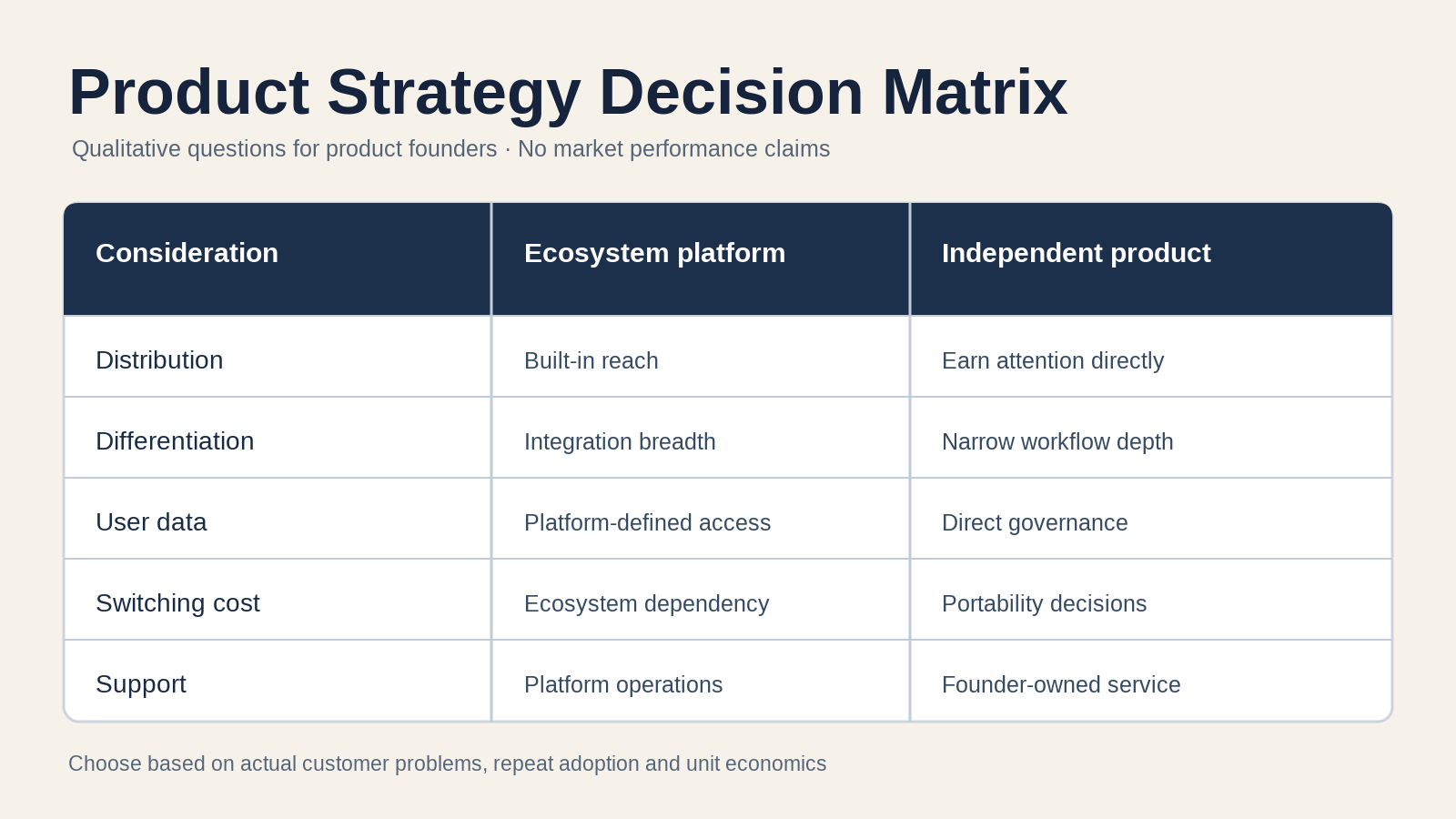
A practical product strategy decision matrix
The choice is not simply “large ecosystem good” or “independent app good.” Each model can be viable, but success depends on different capabilities. Use the matrix below as a set of questions, not a numerical scorecard. A platform product may have easier default discovery while surrendering control over integration and policy. An independent product has more product freedom but must earn attention, trust and service quality independently.
| Dimension | Ecosystem platform | Independent AI product |
|---|---|---|
| Distribution | Existing device and account reach | Must build repeatable acquisition |
| Differentiation | Broad integrated experiences | Narrow workflow and customer depth |
| User data | Platform-governed context and permissions | Direct governance responsibilities |
| Switching cost | May rise with ecosystem integration | Depends on export and interoperability |
| Support | Large-scale platform operations | Founder owns support and reliability |
Neither column proves which business will make more money. Forecasting demand requires actual channel conversion, retention, price sensitivity, support costs and unit economics, not assumptions about AI enthusiasm.
When not to build a competing AI assistant
A founder should decline an attractive-looking category when the proposed product has no unique distribution route, cannot access the data needed to complete the job, relies on forbidden or unstable integrations, or offers only a thin interface over a generic model. Do not build when customers say the idea sounds exciting but cannot identify a repeatable task, current workaround or economic cost.
Be cautious if the application would expose sensitive conversations or devices without a credible privacy model. Voice-based products introduce additional demands for consent, identity, noisy environments, false activations, accessibility and clear feedback about completed actions. Hardware products introduce certification, warranty, inventory and return costs that software-only experiments avoid.
A better alternative is frequently to embed AI in a workflow customers already use, or to sell a narrowly defined service before converting repeated work into software. Both approaches can surface the real requirements without underwriting a speculative platform clone.
A small-market validation plan for independent founders
Use a focused validation sequence before committing to a full build. In week one, interview five to ten prospective buyers who perform the same recurring task. Record the trigger, existing workaround, time or error cost, permission requirements and whether the buyer controls the budget. Ask for examples of the last actual occurrence rather than hypothetical enthusiasm.
In week two, build a clickable prototype or tightly scoped workflow using test data. Show an end-to-end outcome, including approval and error handling, and avoid pretending an integration works when it does not. Ask users to attempt the task while you observe where they hesitate. Track completion, corrections and the steps the operator had to rescue.
In the next pilot, request a real commitment appropriate to the market: a paid trial, signed evaluation agreement, deposit where lawful, or a clearly documented buying process. For each prospect, measure usage against the promised recurring job and make the ongoing support cost visible. A free beta alone cannot establish commercial viability.
Before scaling, define stop criteria: persistent inability to complete the workflow, no repeat usage, integration risk that cannot be mitigated economically, or an acquisition path whose cost exceeds credible contribution margin. Define positive criteria just as explicitly: repeated successful outcomes, credible willingness to pay and a path to serving another similar customer without bespoke work.
The core strategic question is not “Can I build an Apple-like AI product?” It is “Can I repeatedly solve a valuable customer problem with distribution and economics I can control?” Apple HomeView is a timely reminder that interface polish matters, but product-market fit is ultimately a customer and operating-system problem—not a demonstration of model sophistication.
For more evidence-led commentary on product building, explore the Ani Nandi founder journal and the portfolio.