
Amazon Prime Big Deal Days generated intense shopping interest across the United States in October 2026. The two-day event, held on October 6–7, offered shoppers timed promotions in more than 35 categories. For many consumers, the event was about finding deals. For founders, it presents a useful opportunity to examine how large retailers communicate value, prepare seasonal campaigns and help customers navigate purchase decisions.
Search interest is not the same as sales, and sales are not the same as profit. The Google Trends data supplied for this article reported more than one million searches around the broader “Amazon Prime Days” topic over seven days, but that figure does not tell us how many products were bought—or whether any merchant made money. The more worthwhile lesson is in the observable retail mechanics, not an invented performance story.
Running a small ecommerce business is not the same as running Amazon. You cannot copy its logistics footprint, advertising budget or customer base. You can learn from its focus on customer intent, presentation and operational readiness, then apply those ideas on a scale your own business can support.
What happened during Amazon Prime Big Deal Days 2026?
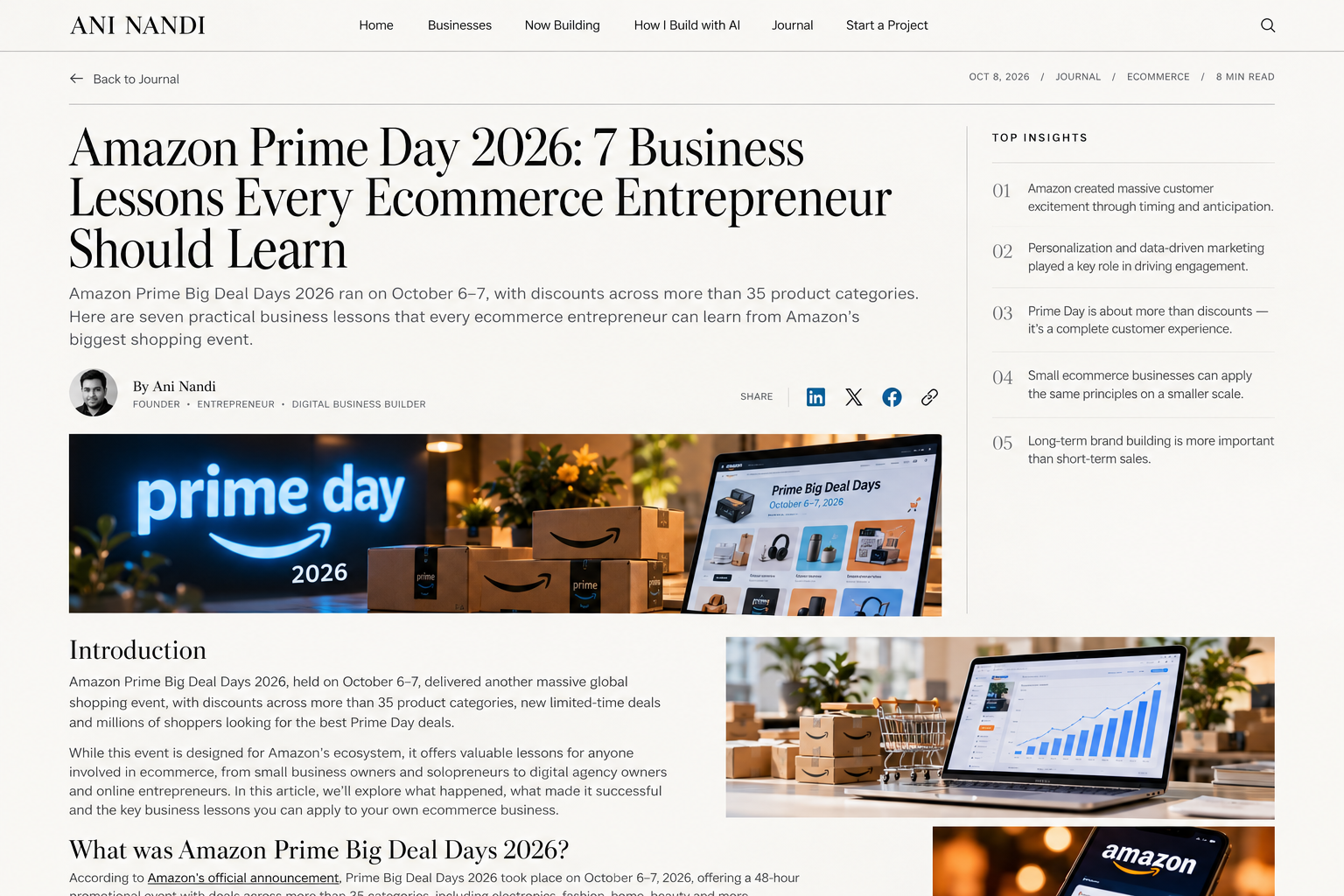
Amazon's official event announcement confirmed a 48-hour shopping event on October 6 and 7 for Prime members, with deals spanning electronics, fashion, beauty, kitchen, home, toys and other categories. Amazon also described new limited-time offers appearing three times daily and its Alexa for Shopping tools for deal discovery and notifications. Those features helped communicate the event as both time-limited and personally relevant to shoppers.
Its timing was deliberate: early October sits ahead of important United States holiday shopping periods, including Halloween and year-end gifting. The event emphasized seasonal preparation and everyday essentials alongside discretionary purchases. Amazon published deal guides and category selections to help customers decide where to look.
It is possible to observe the offer structure, messages, categories and buying journey without having access to private company data. We do not know Amazon's event-level acquisition cost, margin by seller, or conversion performance from those public announcements, and this article does not infer them.
Why entrepreneurs should study major ecommerce events
Established retailers provide visible examples of merchandising: category grouping, clear entry points, timed offers, reminders and purchasing convenience. Studying those details can generate useful hypotheses about what customers respond to. It cannot, by itself, prove which tactic caused a sale.
A small business should approach these events as a research exercise. Look at the language customers use, which product groups receive emphasis, whether offers are easy to understand and how a store reduces confusion. Then evaluate which principles make sense for your particular audience. Large promotions can inspire an experiment; they are not a blueprint to reproduce blindly.
Seven business lessons from Amazon Prime Day 2026
1. Consumer demand matters more than personal product preferences
Principle: product-market fit begins with the buyer, not the founder's enthusiasm. Amazon's event grouped offers around familiar buying missions: preparing homes for the season, shopping for gifts and replacing everyday goods. These are observable customer needs, even though the public pages do not reveal how much each category sold.
Apply it: use Google Trends, on-site search data, customer questions and competitor reviews to find repeated needs. A store selling camping supplies might investigate autumn travel, weatherproof storage and compact cooking gear instead of adding random trending gadgets. Compare search seasonality with customer feedback, not just a single spike.
Avoid: stocking a product simply because you like it or because it appears in a viral video. Action: write down three purchase problems your target customer faces and validate each against actual search or enquiry evidence before sourcing products.
2. Promotions need a clear commercial strategy
Principle: discounts should support a commercial objective, such as introducing a customer to a product or moving seasonal stock, without destroying unit economics. Amazon's timed deals and recurring releases offered clear promotion windows. That does not tell us which participating sellers earned attractive margins.
Consider a hypothetical $60 order. If product and fulfilment costs total $32, transaction fees cost $3 and paid acquisition costs $12, only $13 remains before overhead and refunds. A further $10 discount would leave just $3. This example is arithmetic, not Amazon financial data, but it shows why a headline discount may be a poor founder decision.
Apply it: calculate contribution margin after discounts, shipping, payment fees, advertising and expected returns. Avoid: copying a competitor's percentage markdown without comparing costs. Action: build a price floor for each promoted SKU and refuse offers below it unless a separately justified objective supports the expense.
3. Customer trust is a long-term business asset
Principle: customers must believe that the price, product, delivery expectation and return terms are credible. Major retailers can reinforce confidence through established shopping systems and consistent communication. An independent store must earn that confidence with clarity and execution.
Apply it: show accurate product descriptions, understandable shipping times, visible contact details, clear return policies and authentic customer feedback. If a supplier is overseas, do not promise next-day delivery merely to look competitive. Make checkout costs transparent before the final payment step.
Avoid: artificial scarcity, unsupported product claims and hiding conditions in fine print. Action: have a new visitor complete a test purchase on mobile and record every point at which they hesitate or question the store's legitimacy.
4. Product selection should be guided by research
Principle: what a store chooses not to sell matters almost as much as what it offers. Amazon promoted a wide assortment, but a smaller founder can often compete better through focused curation than sheer catalog size.
Apply it: shortlist products using demand consistency, supplier reliability, product differentiation, return risk and achievable contribution margin. A specialist pet-store owner could organize merchandise around grooming for anxious pets or travel essentials instead of displaying hundreds of unrelated accessories.
Avoid: importing large catalogs without quality checks, supplier samples or information about delivery variability. Action: test five carefully selected products, document the customer problem each solves and measure actual enquiry-to-purchase behavior before expanding.
5. Marketing works best when channels support each other
Principle: customers rarely discover and purchase a product through one predictable touchpoint. Amazon's deal discovery, promotional pages, reminders and seasonal messaging illustrate how multiple contact points can reinforce the same shopping moment. That does not prove the effect of each channel independently.
Apply it: combine evergreen SEO content with segmented email campaigns, relevant social posts and carefully measured advertising. An affiliate marketer might publish a researched comparison before the event, update it when offers change and disclose relevant commercial relationships. A Shopify merchant might use a welcome series, product education and a reminder campaign for people who have explicitly subscribed.
Avoid: broadcasting identical offers indiscriminately or spending across five ad platforms before measuring one. Action: assign each channel a clear job—discovery, education, conversion or retention—and review its incremental contribution after the campaign.
6. Technology and automation should improve operations
Principle: technology is valuable when it reduces errors, delay or repetitive work. Amazon highlighted shopping tools and deal alerts as part of its event, but smaller businesses need not reproduce a complex platform to benefit from automation.
Apply it: use inventory alerts to avoid promoting unavailable products, automatic order-status messages to reduce support enquiries, dashboards to check advertising efficiency and AI-assisted draft descriptions that staff verify against supplier information. An automation that correctly routes a support ticket may have more practical value than an elaborate AI chatbot.
Avoid: unattended AI responses about refunds, product compatibility or delivery guarantees. Action: pick one repetitive task, measure time and errors before automation, and compare outcomes over a controlled pilot.
7. A sustainable business needs more than one sales event
Principle: a promotional peak can create attention, but a durable ecommerce company needs repeatable demand, customer satisfaction and sufficient profit between campaigns. The value of a promotion depends partly on what happens after the purchase.
Apply it: measure repeat purchase rate, first-order contribution margin, returns, support load and retention over time. Offer genuinely useful product education and post-purchase service. A founder who attracts fewer but better-matched customers may create a stronger business than one celebrating a single high-revenue weekend.
Avoid: confusing gross sales with net profit, or using frequent discounting to conceal weak positioning. Action: write a 90-day follow-up plan for every campaign, including service quality and repeat-customer initiatives.
What small ecommerce businesses should avoid copying from Amazon
Amazon's scale creates possibilities unavailable to most founders. Attempting to mirror every aspect can produce avoidable costs. Unprofitable discounting can leave the store busy but cash-poor. An excessive catalog can make discovery harder and inventory quality inconsistent. Aggressive advertising without margin measurement can amplify losses rather than growth.
Equally, a tiny store cannot promise Amazon-like delivery speed unless its actual logistics support it. The objective should not be to compete on price alone, buy an expensive software stack or imitate every site feature. Niche differentiation, honest communication and dependable fulfilment are more defensible starting points.
Compare yourself on the experience you can actually deliver: expertise in a category, transparent guidance, a relevant product assortment and service that solves a specific customer's problem.
How entrepreneurs can build a more sustainable ecommerce business
A practical framework is sequential. Each stage provides evidence for the next rather than requiring a large upfront commitment.
- Research demand: study search questions, seasonal trends, competitor reviews and real customer problems.
- Choose a clear segment: define whom the store serves and why they would prefer it.
- Validate products: check suppliers, quality, returns and initial purchase interest.
- Build a professional storefront: prioritize mobile usability, accessible navigation and accurate product pages.
- Establish trust: publish truthful policies, delivery expectations and responsive contact channels.
- Test marketing: begin with measured experiments in one or two acquisition channels.
- Track unit economics: understand margin, acquisition cost, refunds and contribution per order.
- Improve retention: make purchasing easier for satisfied customers and fix recurrent support problems.
This framework is deliberately less exciting than a weekend of spectacular discounts. It is also easier to govern and evaluate. Growth without operational discipline is fragile.
The role of AI and automation in modern ecommerce
AI is useful when attached to an identifiable workflow. Product research tools can help organize customer feedback, but founders must verify actual demand. Text generation can speed up first drafts of product descriptions, but product specifications, safety claims and prices must be checked against accurate source data.
Customer-service software can triage routine enquiries and suggest replies. Email automation can send relevant messages based on consent and customer behavior. Inventory systems can alert a merchant to low stock, and reporting dashboards can bring sales, returns and advertising costs into one review process. These capabilities are available at different complexity and price levels.
The important qualification is human oversight. A badly connected tool can change the wrong stock figure or send an inaccurate delivery promise at scale. Access controls, audit trails, review checkpoints and recovery procedures should be part of implementation. Businesses exploring specialist software can consider these principles alongside the types of operational systems developed by NIR.Systems, rather than treating AI as a shortcut to running a business unattended.
Building vs buying an online business
There are two broad entry routes. Building from scratch gives a founder direct control of the brand, products, suppliers and technical setup, but demands time for research, development and testing. Buying a ready-made business can reduce the initial site-building work, but does not eliminate marketing, customer support or financial risk.
The meaningful comparison is not simply upfront price. Review what the buyer actually receives: domain rights, platform access, design assets, supplier arrangements, product content, documentation, maintenance responsibilities and any ongoing subscriptions. If the acquisition includes an existing operating business, verify independently any traffic, revenue and profitability claims. If it is a newly built store, do not confuse a launch-ready website with an established customer base.
Through EcomChief, one part of my wider work is ready-made ecommerce and digital businesses. That context reinforces an important distinction: buying a store can simplify setup, but the buyer still needs a viable offer, tested acquisition channels and a credible plan for customer service.
What entrepreneurs should do before the next major shopping event
Use a small preparation checklist rather than attempting a last-minute imitation of a major retailer:
- Four to six weeks ahead: assess seasonal demand and choose a focused set of products; confirm supplier lead times and return conditions.
- Three weeks ahead: calculate promotional price floors including fees, shipping, customer acquisition and possible returns.
- Two weeks ahead: test mobile navigation, checkout, inventory availability and automated customer notifications.
- One week ahead: schedule consent-based emails, prepare useful content and define spending limits for advertisements.
- During the event: monitor actual stock, order problems, campaign performance and customer questions rather than revenue alone.
- After the event: review contribution margin, support issues, product feedback and repeat-purchase opportunities.
No calendar event removes the need to make everyday merchandising and service work well.
Frequently asked questions
What is Amazon Prime Big Deal Days?
A seasonal shopping promotion for Prime members. In 2026, Amazon scheduled the 48-hour October event for October 6–7 across more than 35 product categories.
What can entrepreneurs learn from Amazon Prime Day?
Its publicly observable practices offer lessons in demand research, clear promotional windows, customer trust, focused merchandising, multi-channel communication and operational readiness. They do not reveal private profitability figures.
Can small ecommerce stores compete with major retailers?
Yes, within carefully selected niches. Smaller merchants can offer expertise, relevant selection and honest service instead of trying to match Amazon's size or delivery infrastructure.
How can entrepreneurs identify seasonal product demand?
Combine Google Trends, search queries, supplier insights, customer enquiries and previous store data. Check whether demand persists long enough to support your inventory and marketing commitments.
Are discounts necessary to grow an ecommerce business?
No. Good selection, useful content, service quality, clear positioning and repeat business can matter more. If you discount, calculate contribution margin before launching the promotion.
How can AI help a small ecommerce business?
AI can assist product research, content drafting, support triage and reporting. It should support accurate data and supervised workflows, not invent product facts or make unchecked customer commitments.
What matters most when starting an ecommerce business?
Understanding a specific buyer, validating products and suppliers, building trust and proving profitable acquisition before committing heavily to scale.
A strong business is built between major sales events
The seven lessons are connected: understand real demand, price for sustainable margins, earn trust, select products carefully, coordinate marketing, automate selectively and plan beyond one campaign. Prime Big Deal Days 2026 is a useful case study because its mechanics are visible, not because they guarantee the same results elsewhere.
For independent founders, the goal is not to look like Amazon for two days. It is to create a store that serves a clearly defined customer well on ordinary days. Research, customer understanding and disciplined operations make that possible; promotional events merely provide opportunities to test the foundation.